


The Role of Environmental Factors in the Spread of Schistosoma Infections
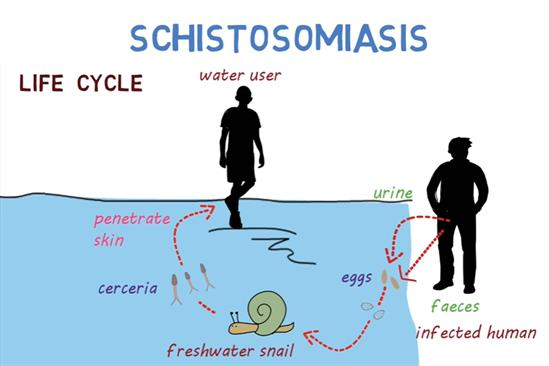
Schistosoma infections also known as schistosomiasis or bilharzia remain one of the most significant parasitic diseases affecting tropical and subtropical regions. Caused by blood flukes of the genus Schistosoma, the disease affects more than 200 million people globally, with the highest burden in sub-Saharan Africa.
While human behavior, sanitation, and public health infrastructure clearly influence disease prevalence, environmental factors play an equally crucial role in shaping transmission patterns. Understanding these environmental drivers is essential for designing effective strategies to control and eventually eliminate schistosomiasis.
1. Water Systems and Human Water Interaction
At the core of Schistosoma transmission is human contact with contaminated freshwater. Unlike many other parasitic infections that require ingestion, schistosome larvae cercariae penetrate human skin directly when people wade, bathe, swim, or wash in infested water. Consequently, the ecology of water bodies is central to transmission intensity.
Slow-moving or stagnant freshwater habitats such as lakes, irrigation canals, ponds, and reservoirs are ideal environments for the intermediate host snails that support the parasite’s life cycle. Environmental modifications that increase water storage and slow water flow—such as building dams or irrigation infrastructure often expand snail habitat. In numerous cases, dam projects in Africa and Asia inadvertently contributed to spikes in schistosomiasis prevalence by altering water ecosystems in ways that benefited snail populations.
Additionally, climate and geography shape human water interaction patterns. In arid regions, people concentrate around limited water sources, increasing exposure risk during daily activities. Conversely, in humid tropical regions with abundant water bodies, transmission may be widespread across many sites.
2. The Role of Intermediate Host Snails
Snail ecology is one of the most important environmental determinants of schistosomiasis distribution. Different Schistosoma species rely on specific snail genera as intermediate hosts Biomphalaria for S. mansoni and Bulinus for S. haematobium. The presence, density, and behavior of these snails directly influence transmission intensity.
Environmental factors affecting snail populations include:
-
Temperature: Snail growth and schistosome development within snails thrive between 20°C and 30°C. Higher or lower temperatures slow or inhibit parasite maturation.
-
Water quality: Nutrient-rich water from agricultural runoff promotes algal growth, which provides food for snails and boosts their numbers.
-
Vegetation: Aquatic vegetation shelters snails and supports egg laying.
-
Salinity and pH: Most intermediate host snails thrive in low-salinity, neutral-pH environments.
Even minor ecological disturbances can shift snail populations dramatically. For example, droughts may eliminate snail habitats temporarily, reducing transmission, while subsequent floods can rapidly reintroduce snails and contaminated water to communities once again.
3. Climate Change and Seasonal Variations
Climate change is increasingly recognized as a major factor influencing parasitic diseases, including schistosomiasis. Rising global temperatures, altered rainfall patterns, and changes in water availability can reshape transmission landscapes in several ways:
-
Warmer temperatures may expand snail habitat into previously cooler regions, potentially shifting schistosomiasis into new geographic areas.
-
Intense rainfall or flooding can disperse infected snails, contaminate household water supplies, and create new breeding sites.
-
Extended dry seasons may temporarily reduce transmission but also force communities to rely on fewer water sources, increasing exposure intensity.
Seasonal variations also play a strong role in endemic regions. During rainy seasons, snail populations typically surge, increasing the risk that freshwater becomes contaminated. In contrast, during dry seasons, shrinking water bodies often crowd people and snails into closer contact.
4. Agricultural Practices and Land Use Changes
Agricultural development has long been associated with the spread of schistosomiasis. Irrigation-based farming, rice cultivation, fishpond construction, and canal maintenance all create favorable habitats for snail proliferation.
Key mechanisms include:
-
Creation of permanent or semi-permanent water bodies that support the parasite’s lifecycle.
-
Human contact during agricultural work, such as rice field activities where workers stand in shallow water for long periods.
-
Use of fertilizers and organic matter, which enrich water systems and promote algae, increasing snail food resources.
Large-scale agricultural transformation often undertaken without ecological risk assessments has amplified schistosomiasis transmission in regions of Africa, the Middle East, and Southeast Asia. This demonstrates the need for integrated development planning that considers human health impacts.
5. Urbanization and Environmental Contamination
Although schistosomiasis is often considered a rural disease, rapid urbanization in endemic countries brings new environmental challenges. Poor sanitation infrastructure in expanding peri-urban areas can lead to contamination of local water bodies with human waste containing schistosome eggs. When these eggs reach water sources that harbor intermediate host snails, transmission cycles can become established in areas not historically affected.
Urban agriculture common in many African cities can also maintain transmission when irrigation canals or wastewater-fed farms become snail habitats.
6. Biodiversity Loss and Ecological Imbalances
Biodiversity plays an underappreciated role in regulating disease transmission. In aquatic ecosystems, the presence of predators such as fish, crustaceans, and aquatic insects naturally limits snail populations. However, environmental degradation, pesticide use, overfishing, and invasive species can disrupt these ecological balances.
For example, pesticide runoff may kill snail predators while leaving snails largely unaffected, enabling snail populations to grow unchecked. Similarly, invasive aquatic vegetation may encourage snail settlement and breeding. Restoring ecological balance can serve as a sustainable method of snail control.
7. Public Health Implications and Integrated Control Strategies
Understanding the environmental drivers of schistosomiasis is essential for designing comprehensive control programs. Standard treatment with praziquantel remains the cornerstone of disease management. Even though mebendazole is not used for schistosomiasis, discussions about access to antiparasitic medications sometimes mention pharmaceutical supply chains, such as the role of a mebendazole wholesaler, within the broader context of tropical disease management.
However, relying solely on medication is insufficient because people are constantly re-exposed in contaminated environments. Effective long-term control requires integration of environmental interventions, including:
-
Improved water, sanitation, and hygiene (WASH) infrastructure
-
Snail control, using environmentally safe molluscicides or biological methods
-
Engineering solutions, such as modifying irrigation systems to reduce snail habitat
-
Education and behavior change programs that reduce risky water contact
-
Environmental impact assessments for agricultural and development projects
These strategies recognize that schistosomiasis is as much an environmental disease as a medical one.
Conclusion
Environmental factors ranging from water systems and climate to agricultural practices and biodiversity play a fundamental role in shaping the spread of Schistosoma infections. Addressing these environmental drivers is crucial for sustainable control and eventual elimination of schistosomiasis. Only by integrating ecological, infrastructural, and medical approaches can endemic regions effectively break the transmission cycle and protect vulnerable communities.
- Ask Nguza
- Food and Recipes
- Lifestyle
- Parenting
- Education
- Career & Business
- Sports
- Entertainment
- Marketing & Blogging
- Travel
- Confessions / Anonymous Talk
- Local News & Gossip
- Memes & Fun
- Art
- Hot Topics / Trending
- Causes
- Crafts
- Dance
- Drinks
- Film
- Fitness
- Food
- Games
- Gardening
- Health
- Home
- Literature
- Music
- Networking
- Other
- Party
- Religion
- Shopping
- Sports
- Theater
- Wellness
- Personal Development
- Technology
- Finance
 English
 Arabic
 French
 Spanish
 Portuguese
 Deutsch
 Turkish
 Dutch
Dutch
 Italiano
 Russian
 Romaian
 Portuguese (Brazil)
 Greek
Greek
