


Packaging Printing Market Size and Forecast Analysis Through 2035
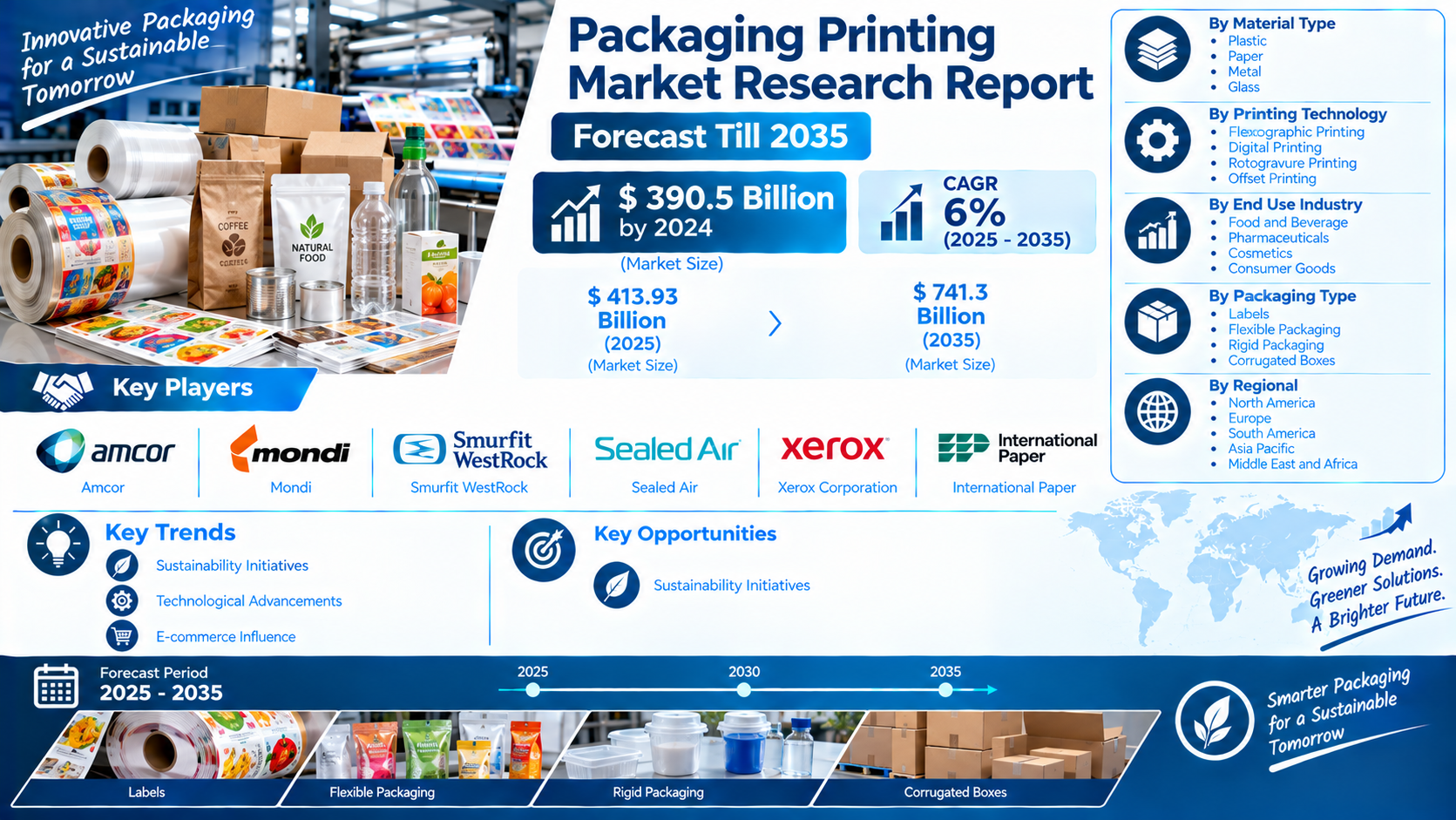
According to Market Research Future® (MRFR), the Packaging Printing Market is forecast to grow from USD 413.93 Billion in 2025 to USD 741.3 Billion by 2035, registering a CAGR of 6% over the forecast period. The market was valued at USD 390.5 Billion in 2024. Its expansion is linked to the widespread use of printed packaging in food and beverage, pharmaceutical, cosmetics, and consumer goods industries. Changes in purchasing channels, greater attention to sustainability, and improvements in printing processes are also shaping demand.
Market Overview
Printed packaging serves several functions in modern product supply chains. It provides product identification and information, supports branding, and helps packages meet the presentation needs of retail and distribution. Companies use printing on different materials and formats according to product characteristics, production volumes, regulatory requirements, and customer expectations.
The market includes plastic, paper, metal, and glass materials, with printing technologies such as flexographic printing, digital printing, rotogravure printing, and offset printing. Labels, flexible packaging, rigid packaging, and corrugated boxes represent key packaging formats. These segments differ in their physical properties, manufacturing processes, and commercial applications. Choosing the right combination involves balancing print quality, durability, material suitability, production speed, and total cost.
Market Size and Forecast Outlook
The market's valuation is projected to rise from USD 390.5 Billion in 2024 to USD 413.93 Billion in 2025 and USD 741.3 Billion by 2035. The expected CAGR of 6% between 2025 and 2035 reflects anticipated growth in printed packaging requirements across multiple industries.
Food and beverage producers require packaging that communicates product information and reinforces brand recognition. Pharmaceutical companies need clear, accurate labeling and packaging suited to the relevant product. Cosmetics manufacturers often place emphasis on presentation and visual differentiation, while consumer goods companies use printed packaging to communicate product features and maintain consistent branding.
The range of packaging formats creates opportunities for suppliers with different technical capabilities. Labels may be used across numerous container types, flexible packaging supports adaptable product formats, and rigid packaging serves applications where structure and presentation are important. Corrugated boxes contribute to shipping and storage, including the distribution requirements associated with online purchases.
Growth Opportunities
Sustainability initiatives represent a key opportunity identified for the market. Brand owners and packaging suppliers can assess material use, production waste, recyclability, and the compatibility of packaging with local recovery systems. Design changes may reduce unnecessary material use or improve the suitability of a package for recycling, provided the packaging continues to meet protection and performance requirements.
Printing providers can also explore technology choices that improve efficiency or reduce waste. Digital printing may be suitable for customized designs, variable information, and shorter runs, while other printing processes may be appropriate for larger volumes or particular substrates. Selecting a process based on the job's requirements can help manufacturers manage cost and maintain consistent output.
E-commerce-related packaging offers another avenue for development. Products sold online must withstand handling and shipping, while packaging can still serve as a communication and branding surface. Suppliers that understand both print requirements and the practical needs of distribution can support customers across retail and online sales channels.
Regional Analysis
The market covers North America, Europe, South America, Asia Pacific, and the Middle East and Africa. Demand across these regions is influenced by manufacturing activity, consumer goods production, packaging preferences, e-commerce development, and the availability of printing and converting capabilities.
North America and Europe have diverse packaging requirements across food, pharmaceuticals, cosmetics, and consumer products. Sustainability considerations and packaging design can influence purchasing decisions, although the requirements vary by application and local infrastructure. Asia Pacific offers opportunities linked to manufacturing activity, consumer markets, and the production of packaged goods. South America and the Middle East and Africa provide additional demand channels shaped by local industry development and distribution needs.
Regional differences affect the materials and technologies selected by packaging customers. Regulations, recycling infrastructure, production costs, and access to suppliers can influence the feasibility of particular formats. Companies serving multiple regions must adapt products and processes to local requirements rather than assume that a single packaging approach will work everywhere.
Recent Industry Developments
Sustainability initiatives, technological advancements, and e-commerce influence are major themes in packaging printing. These represent broad industry trends rather than claims of specific dated announcements by individual companies.
Printing technology continues to provide options for different production volumes, design requirements, and material formats. Digital processes can support customization, while flexographic, rotogravure, and offset printing remain relevant for applications with different technical and economic needs. Meanwhile, sustainability efforts encourage businesses to examine packaging design, material efficiency, and waste management throughout production and recovery.
E-commerce continues to shape how packaging is used during fulfillment and delivery. Printed boxes and other formats must balance identification and branding with protection during handling and transport.
Market Challenges
Packaging printers must manage material costs, equipment investment, production efficiency, and the need to meet changing customer specifications. Different substrates require suitable inks, processes, and finishing methods, and print quality must remain consistent across production runs. Shorter runs and customized orders can also increase operational complexity if workflows are not appropriately configured.
Sustainability goals introduce further considerations. A material or coating may offer benefits in one area but create challenges for recyclability, durability, or cost. Packaging suppliers must evaluate the complete design and its intended recovery pathway. They also need to ensure that changes do not compromise product protection or essential information.
Competitive Landscape
Amcor, Mondi, Smurfit WestRock, Sealed Air, Xerox Corporation, and International Paper are among the key companies identified in the market. Competition depends on product range, printing capabilities, material expertise, manufacturing efficiency, customer service, and the ability to meet varied packaging specifications.
Companies can strengthen their position by investing in appropriate technology, improving production workflows, and supporting customers' sustainability objectives with practical packaging solutions. Collaboration between packaging producers, brand owners, and printing specialists can help align design with production and distribution requirements. With the market projected to reach USD 741.3 Billion by 2035, long-term opportunities will depend on the growth of end-use industries, evolving e-commerce needs, and the industry's ability to combine effective printing with cost and environmental considerations.
- Ask Nguza
- Food and Recipes
- Lifestyle
- Parenting
- Education
- Career & Business
- Sports
- Entertainment
- Marketing & Blogging
- Travel
- Confessions / Anonymous Talk
- Local News & Gossip
- Memes & Fun
- Art
- Hot Topics / Trending
- Causes
- Crafts
- Dance
- Drinks
- Film
- Fitness
- Food
- Oyunlar
- Gardening
- Health
- Home
- Literature
- Music
- Networking
- Other
- Party
- Religion
- Shopping
- Sports
- Theater
- Wellness
- Personal Development
- Technology
- Finance
 Turkish
 English
 Arabic
 French
 Spanish
 Portuguese
 Deutsch
 Dutch
 Italiano
 Russian
 Romaian
 Portuguese (Brazil)
 Greek
