


3D Medical Imaging Devices Market Growth, Trends, Company Profiles, Market Share Analysis By Fact.MR
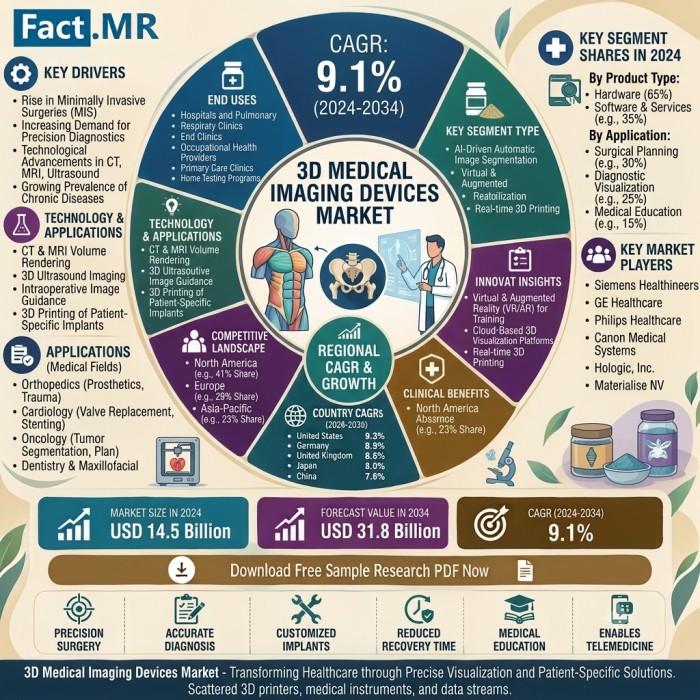
Rockville, Maryland — October 7, 2026 : The global 3D medical imaging devices market is projected to expand from USD 15.2 billion in 2026 to USD 39.8 billion by 2036, advancing at a 10.1% CAGR during the forecast period. Fact.MR estimates an absolute dollar opportunity of USD 24.6 billion through 2036 as hospitals and imaging centers strengthen depth-based diagnostic workflows, replace aging equipment, and adopt technologies that support more detailed anatomical visualization.
Get detailed market forecasts, competitive benchmarking, and pricing trends:
The market is increasingly being shaped by the need for better diagnostic depth and more effective treatment planning. Radiology departments are using 3D imaging to improve anatomical review, while surgeons increasingly rely on three-dimensional views when preparing for complex orthopedic and oncology procedures. Replacement of legacy scanners is another important contributor, as hospitals seek improved image quality, reporting workflows, and compatibility with software-assisted imaging systems. The shift is moving purchasing decisions beyond hardware specifications toward complete clinical workflow requirements.
Among product categories, 3D CT systems are expected to remain the leading segment, accounting for 34.0% of the market in 2026. Their broad use in emergency care, anatomical assessment, and surgical planning supports their leading position. Diagnostic imaging is projected to represent 41.0% of application demand, while 3D reconstruction software is expected to hold a 32.0% share within technology. Hospitals remain the dominant end-user group with an estimated 48.0% share, reflecting their ability to manage advanced imaging workloads across radiology, emergency care, oncology, and surgical departments. Direct sales are forecast to account for 52.0% of sales channels as high-value imaging systems require installation, training, and ongoing service support.
China is projected to be the fastest-growing country in the 3D medical imaging devices market, advancing at a 12.6% CAGR through 2036. Expansion of hospital imaging capacity, specialist care, and advanced diagnostic infrastructure is expected to support adoption, particularly across large urban hospitals. India follows with a 12.1% CAGR as private hospital networks and diagnostic center infrastructure expand. Rising access to advanced imaging in metropolitan and tier-two cities is creating additional opportunities for equipment suppliers. Germany is forecast to grow at a 9.5% CAGR, supported by hospital modernization, specialist care requirements, and replacement demand. The United States is expected to register a 10.4% CAGR, while Japan is projected to grow at 8.8% as established healthcare infrastructure, aging-care needs, and equipment replacement sustain demand.
Technology development is also broadening the addressable market. Three-dimensional reconstruction software enables radiology departments to transform scan data into more usable anatomical views, while volume rendering supports detailed examination of complex structures. AI-enabled image analysis can assist clinicians facing large imaging workloads, and real-time 3D imaging can support interventional procedures. Cone beam imaging also provides targeted visualization for selected clinical workflows. For hospitals, the value of these technologies increasingly depends on compatibility with existing imaging infrastructure, reporting systems, storage capacity, and clinical processes.
Despite favorable demand conditions, high system costs remain a restraint, particularly for smaller healthcare facilities. Advanced MRI and interventional imaging systems require substantial capital investment along with trained personnel, installation resources, and ongoing maintenance. Data storage and service expenses can further increase total ownership costs. These considerations may encourage smaller diagnostic centers and specialty clinics to consider distributor-led purchasing, leasing, rental models, or service-linked arrangements rather than large upfront equipment investments. Suppliers that combine equipment with training, maintenance, software support, and lifecycle services can address these purchasing barriers more effectively.
The competitive landscape includes GE HealthCare Technologies Inc., Siemens Healthineers AG, Koninklijke Philips N.V., Canon Medical Systems Corporation, and FUJIFILM Healthcare Corporation. These companies compete across imaging hardware, advanced visualization, software-assisted workflows, and service capabilities. Competitive differentiation increasingly depends on image quality, workflow integration, installed-base support, application training, and service reliability rather than equipment alone. Hospitals are also evaluating how efficiently new systems connect with existing clinical and reporting infrastructure.
Unlock 360° insights for strategic decision making and investment planning:
The market presents opportunities for suppliers developing AI-assisted imaging capabilities, compact systems for specialty clinics, and service contracts that strengthen post-installation revenue. As healthcare providers seek more detailed anatomical visualization and faster movement from imaging to clinical decision-making, integrated combinations of devices, reconstruction software, analytics, and workflow support are likely to gain importance. Fact.MR’s 3D Medical Imaging Devices Market report provides detailed analysis across product type, application, technology, end user, sales channel, and major country markets, covering the forecast period from 2026 to 2036.
Explore More Related Studies Published by Fact.MR Research
Non-Invasive Diagnostic Tests Market
Disposable Spirometry Filters Market
Dual-Chamber Cartridge Plungers Market
Elastomeric Pump Cartridges Market
CPAP Humidifier Chambers Market
About Fact.MR
Fact.MR is a market research and consulting firm providing syndicated research, customized research, investment research, and market intelligence across a broad range of industries. Its research coverage includes food and beverage, healthcare, pharmaceuticals, biotechnology, consumer products, chemicals and materials, technology, industrial goods, and packaging.
Fact.MR provides market intelligence designed to help organizations understand market dynamics, emerging opportunities, competitive developments, and changing industry requirements.
Media Contact
Fact.MR
Email: [email protected]
Phone: +1 (628) 251-1583
Website: www.factmr.com
- Ask Nguza
- Food and Recipes
- Lifestyle
- Parenting
- Education
- Career & Business
- Sports
- Entertainment
- Marketing & Blogging
- Travel
- Confessions / Anonymous Talk
- Local News & Gossip
- Memes & Fun
- Art
- Hot Topics / Trending
- Causes
- Crafts
- Dance
- Drinks
- Film
- Fitness
- Food
- Jogos
- Gardening
- Health
- Início
- Literature
- Music
- Networking
- Outro
- Party
- Religion
- Shopping
- Sports
- Theater
- Wellness
- Personal Development
- Technology
- Finance
 Portuguese
 English
 Arabic
 French
 Spanish
 Deutsch
 Turkish
 Dutch
Dutch
 Italiano
 Russian
 Romaian
 Portuguese (Brazil)
 Greek
Greek
