


BIS Certification for Stainless Steel Butt Hinges – Complete Guide
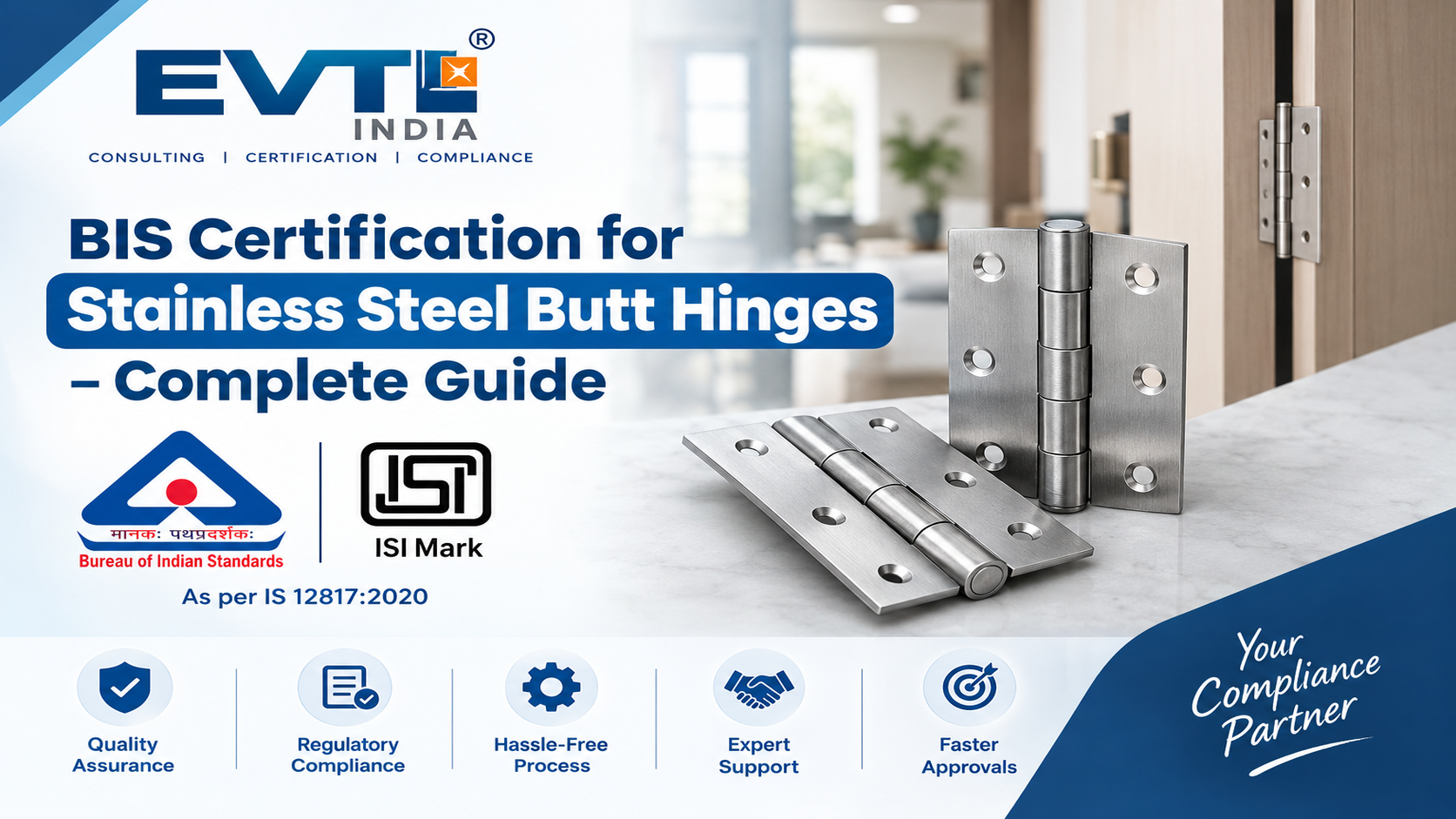
Stainless steel butt hinges are used to connect doors, windows, cabinets, cupboards, and other movable parts. They help these parts open and close smoothly. Since hinges are used regularly, their size, material, construction, and finish need to be properly controlled. BIS For Stainless steel butt hinges helps manufacturers understand the quality requirements that apply to these products in India. The relevant Indian Standard for this product is IS 12817:2020.
What Are Stainless Steel Butt Hinges?
A butt hinge is a simple hardware fitting made of two metal leaves joined together with a pin. One leaf is fixed to the door or other movable part, while the other is fixed to the frame. The leaves rotate around the pin when the door is opened or closed.
Stainless steel is commonly used for these hinges because it offers good strength and resistance to rust and corrosion. These hinges are used in homes, offices, commercial buildings, furniture, cabinets, and many other applications.
Why Is BIS Certification Important?
BIS Certification for stainless steel butt hinges helps show that the product has been checked against the requirements of the applicable Indian Standard. Where certification is made mandatory through the applicable Quality Control Order, manufacturers need to follow the required BIS compliance process.
BIS certification is not only about obtaining a licence. The manufacturer also needs to maintain suitable production, testing, inspection, and quality-control arrangements. This helps ensure that the product continues to meet the required quality level.
Applicable Indian Standard – IS 12817:2020
The applicable Indian Standard for stainless steel butt hinges is IS 12817:2020. This standard covers important requirements related to the material, dimensions, manufacturing, construction, and finish of stainless steel butt hinges.
The standard gives manufacturers a common quality reference. It helps them understand what characteristics their hinges should meet before the products are supplied in the market.
Manufacturers should also check the latest BIS requirements and applicable Quality Control Order before starting the certification process because regulatory requirements may be updated.
Where Are Stainless Steel Butt Hinges Used?
Stainless steel butt hinges are used in many places where a door, window, cabinet, or similar part needs to move around a fixed point.
Common applications include:
- Residential doors
- Commercial doors
- Office furniture
- Cabinets and cupboards
- Windows
- Storage units
- Furniture products
- Other building hardware
The required hinge size, thickness, material grade, and design can vary depending on the application.
Main Testing Requirements
Testing is an important part of the BIS certification process. The product needs to be checked against the requirements applicable to its type and scope.
Some important areas include:
- Dimensions and tolerances
- Manufacturing quality
- Finish
- Material requirements
- Construction and workmanship
- Hole size and position
- Pin and hinge-leaf characteristics
- Marking requirements
Testing helps confirm that the actual product manufactured by the company matches the applicable requirements.
Material Requirements
The quality of stainless steel used in the hinge is an important factor. The material used for different parts of the hinge should meet the requirements specified by the applicable standard.
Manufacturers should maintain proper records of the raw materials used in production. Good control over incoming material can help reduce quality problems during manufacturing and testing.
Who Needs BIS Certification?
Manufacturers producing stainless steel butt hinges for the Indian market should check whether their products are covered by the applicable mandatory certification requirements.
This may include:
- Indian manufacturers
- Foreign manufacturers supplying products to India
- Manufacturers producing hinges under their own brand
- Businesses planning to introduce these products into India
Importers and traders should also verify the certification status of the manufacturer when dealing with products covered by mandatory BIS requirements.
Documents Usually Required
Before applying, manufacturers should prepare the documents related to their company, factory, product, manufacturing process, and quality-control system.
Common documents may include:
- Company registration details
- Factory address and contact details
- Manufacturing process flow chart
- Product drawings and specifications
- List of manufacturing machinery
- Testing equipment details
- Calibration records
- Raw-material details
- Quality-control information
- Details of technical staff
- Product test reports, where applicable
- Authorisation documents, where required
The exact documents can vary according to the application and the manufacturer's circumstances.
BIS Registration and Certification Process
BIS Registration for stainless steel butt hinges involves more than simply submitting an online form. The manufacturer needs to meet the applicable product and factory requirements.
The process may involve document preparation, application submission, product testing, factory inspection, correction of observations, and final evaluation by BIS. The licence is granted after the required conditions are successfully fulfilled.
Step-by-Step BIS Certification Process
1. Check the Applicable Standard
First, the manufacturer should identify the correct Indian Standard and confirm the applicable regulatory requirements for the product.
2. Prepare the Documents
The required company, factory, product, manufacturing, testing, and quality-control documents should be collected and checked.
3. Submit the Application
The application is submitted to BIS with the required information and applicable fees.
4. Product Testing
Samples are tested according to the applicable requirements. The manufacturer should ensure that the samples properly represent the products intended to be covered under the certification.
5. Factory Inspection
BIS may inspect the manufacturing facility to check production arrangements, testing facilities, quality-control practices, and other relevant requirements.
6. Resolve Observations
If any issue is found during testing or inspection, the manufacturer may need to take corrective action and provide the required information.
7. Grant of Licence
After successful evaluation, BIS can grant the licence according to the applicable certification procedure.
Factory Inspection and Quality Control
A proper quality-control system is important for maintaining consistent product quality. The manufacturer should control important stages of production instead of checking only the finished hinges.
Important production stages may include:
- Stainless steel raw material inspection
- Cutting and forming
- Hole making
- Knuckle formation
- Pin preparation
- Assembly
- Finishing
- Final inspection
- Product marking
The manufacturer should also maintain suitable inspection records and ensure that testing equipment is properly maintained and calibrated where required.
Understanding BIS ISI Mark Requirements
BIS ISI Mark For stainless steel butt hinges is important because the mark helps identify products covered by a valid BIS licence.
Manufacturers should not use the ISI Mark merely because they have submitted an application. The mark should be used only after the required licence has been granted and according to the conditions specified by BIS.
The product sold with the ISI Mark should also remain within the approved scope of the licence.
Scope of the BIS Licence
The scope of a BIS licence is an important point for manufacturers. A company may manufacture different sizes, designs, thicknesses, or material grades of stainless steel butt hinges.
However, every product variety may not automatically be covered under one licence. The manufacturer should clearly identify the products and varieties for which certification is required.
If a manufacturer later wants to add a new product variety or make a significant change, it should check whether BIS approval or scope extension is required.
Common Mistakes to Avoid
Manufacturers can face delays when they begin the certification process without properly checking their product and documents.
Some common mistakes include:
- Providing incomplete documents
- Choosing an incorrect product scope
- Submitting unsuitable samples
- Not checking raw-material requirements
- Ignoring calibration records
- Poor preparation for factory inspection
- Using the ISI Mark before receiving the licence
- Making product changes without checking certification requirements
Proper preparation before submitting an application can help reduce unnecessary delays.
Benefits of BIS Compliance
Following the required BIS process can provide several benefits to manufacturers.
These include:
- Better control over product quality
- Compliance with applicable Indian requirements
- Greater confidence among buyers
- Better understanding of manufacturing quality
- Support for lawful market access where certification is mandatory
- Improved control over testing and inspection
For manufacturers planning to supply products in India for the long term, maintaining proper compliance is an important part of business planning.
How EVTL India Can Help
The BIS certification process can be difficult for manufacturers who are applying for the first time. Understanding the standard, preparing documents, arranging testing, and getting ready for factory inspection can require proper planning.
EVTL India can support manufacturers through different stages of the certification process. This may include documentation support, testing coordination, application assistance, inspection preparation, and guidance on applicable compliance requirements.
The aim is to make the certification journey easier to understand and help manufacturers prepare their products and factory properly.
Conclusion
EVTL India is one of the leading BIS Consultant in India, helping manufacturers obtain their BIS licenses hassle-free. Stainless steel butt hinges may look like simple hardware products, but their quality depends on the right material, dimensions, manufacturing, finishing, and inspection. Following IS 12817:2020 helps manufacturers understand the quality requirements that apply to these products.
EVTL India can assist manufacturers with documentation, testing coordination, BIS application support, factory inspection preparation, and other compliance requirements. Proper preparation can make the certification process easier and help manufacturers avoid common delays.
For assistance with stainless steel butt hinge certification, contact EVTL India:
📞 +91 95609 35898
📧 [email protected]
🌐 www.evtlindia.com
- Ask Nguza
- Food and Recipes
- Lifestyle
- Parenting
- Education
- Career & Business
- Sports
- Entertainment
- Marketing & Blogging
- Travel
- Confessions / Anonymous Talk
- Local News & Gossip
- Memes & Fun
- Art
- Hot Topics / Trending
- Causes
- Crafts
- Dance
- Drinks
- Film
- Fitness
- Food
- Jeux
- Gardening
- Health
- Domicile
- Literature
- Music
- Networking
- Autre
- Party
- Religion
- Shopping
- Sports
- Theater
- Wellness
- Personal Development
- Technology
- Finance
 French
 English
 Arabic
 Spanish
 Portuguese
 Deutsch
 Turkish
 Dutch
Dutch
 Italiano
 Russian
 Romaian
 Portuguese (Brazil)
 Greek
Greek
