


Which Cyber Security Projects Can Make a Fresher’s Resume More Interview-Ready?

For a fresher, a resume filled with certifications and technical terms may not be enough to demonstrate practical ability. Cyber Security projects can give candidates real examples to discuss during interviews and show how they apply security concepts to realistic situations. Projects related to network defense, vulnerability management, security monitoring, application protection, and incident response can help build a stronger portfolio. Learners pursuing aCyber Security Course in Chennai can use project work to strengthen their technical foundation while developing the confidence needed to explain security problems and solutions to interviewers.
What Makes a Cyber Security Project Valuable for a Fresher?
A useful project should solve a clear security-related problem and have a defined outcome. Freshers can document the objective, environment, tools, observations, and recommendations instead of simply listing technologies on their resumes. Even a small project can demonstrate analytical thinking when the candidate understands every step involved. Projects should also be completed in authorized labs or practice environments. During an interview, being able to explain why a particular approach was selected can make the project more meaningful than simply mentioning its name.
Can Network Defense Projects Highlight Core Security Skills?
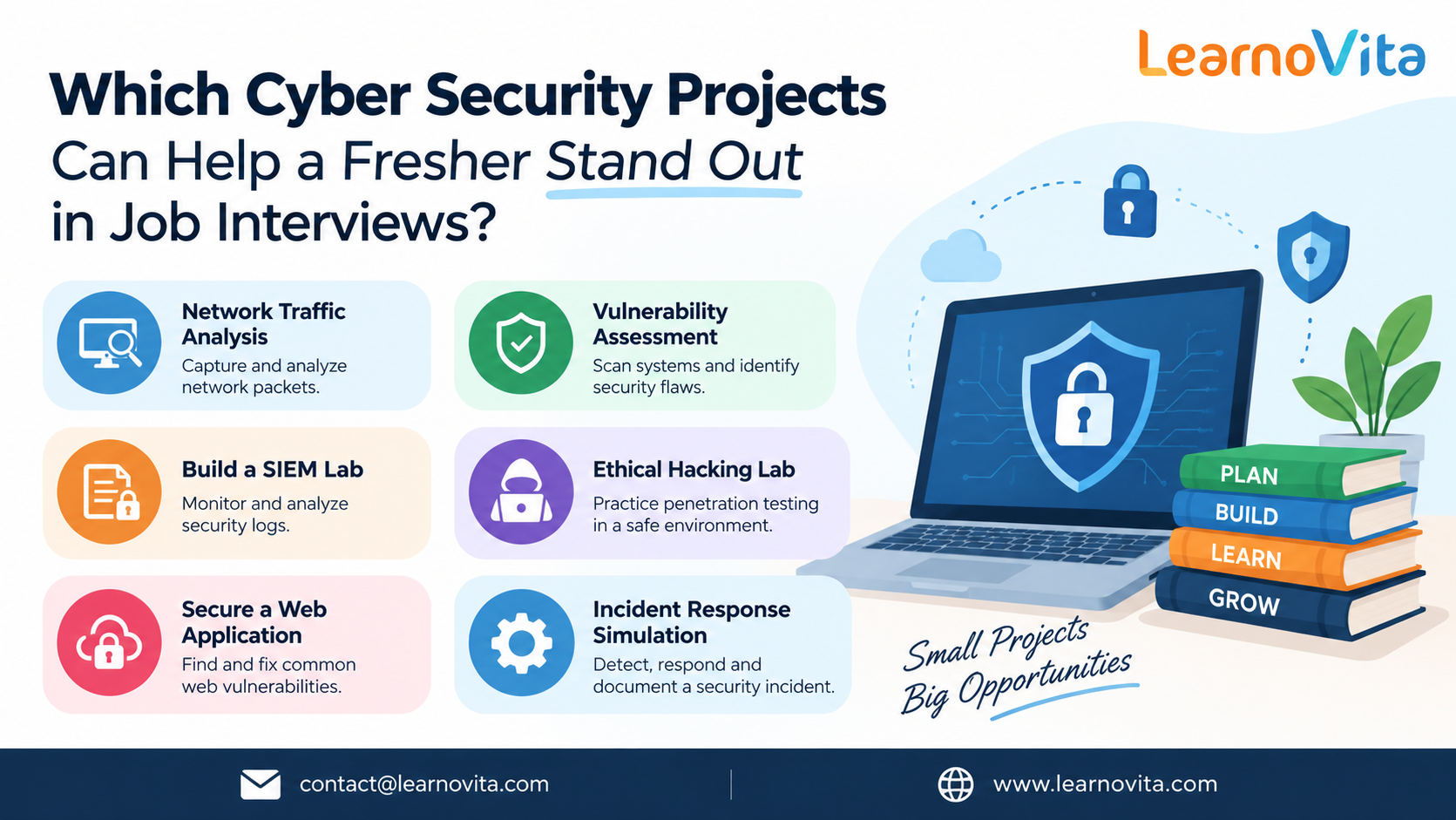
Network defense is a good starting point for candidates who want to understand how systems communicate and how suspicious activity can be identified. A beginner project could involve monitoring traffic within a controlled lab and analyzing common network events. Candidates can document protocols, unusual patterns, and possible defensive controls. They can also explain how firewalls, segmentation, secure configurations, and monitoring contribute to network protection. This gives freshers a practical way to demonstrate networking fundamentals while connecting them with Cyber Security concepts.
How Can Vulnerability Management Projects Improve a Portfolio?
Vulnerability management involves finding security weaknesses, understanding their potential impact, and recommending ways to reduce risk. A fresher can create a project using an intentionally vulnerable training environment and prepare a structured assessment report. The report can categorize findings, explain their importance, and suggest appropriate remediation. This approach helps candidates understand that security work is not only about identifying problems but also about communicating them clearly. Students undertaking Cyber Security Training in Bangalore can use this type of project to connect vulnerability concepts with practical security workflows.
Is a Security Awareness Project Suitable for Beginners?
Yes, security awareness can make an effective beginner project because human behavior is an important part of organizational security. A candidate can create a simulated awareness program covering phishing indicators, password safety, suspicious attachments, social engineering risks, and secure browsing habits. Fictional examples can be used instead of targeting real users. The final project could include an awareness presentation, checklist, or short training guide. Such a project demonstrates that the candidate understands how employees and security teams can work together to reduce common security risks.
Could Log Analysis Be a Strong Project for Security Roles?
Log analysis can introduce freshers to the type of information security teams examine when investigating unusual activity. Candidates can work with sample authentication, application, or system logs in a controlled environment. They can identify patterns such as repeated failed logins, unexpected access attempts, or unusual system events and explain why those events might require investigation. A final report can summarize observations and recommended actions. This project can be particularly useful for candidates interested in security operations and the monitoring concepts covered in Cyber Security Training in Hyderabad. .
What Can a Web Application Security Project Demonstrate?
A web security project can show that a fresher understands how application design and configuration can affect security. Candidates can use intentionally vulnerable educational applications to study issues involving authentication, access control, input validation, and session management. The project should focus on understanding the weakness and explaining the appropriate defensive solution. Freshers can include screenshots and a short remediation report in their portfolio. During an interview, they can discuss the root cause, possible impact, and steps developers or security teams can take to reduce the risk.
Why Should Freshers Consider an Incident Response Project?
Incident response projects can help candidates demonstrate their ability to think through a security event in an organized manner. A project might simulate suspicious account activity, an unusual system alert, or another fictional security incident. The candidate can document how the event was identified, what evidence was reviewed, how the situation could be contained, and what preventive actions could follow. This gives interviewers an opportunity to assess the candidate's reasoning. It also helps freshers become familiar with concepts such as investigation, documentation, containment, recovery, and lessons learned.
Can Cloud Security Projects Make a Fresher's Portfolio More Relevant?
Cloud platforms introduce several security considerations, including identity management, access permissions, data protection, monitoring, and secure configuration. A beginner can build a project around one of these areas using an authorized learning account or lab. For example, the project could demonstrate how access permissions are reviewed or how security logs can be monitored. Candidates should document the environment and avoid using sensitive information. A cloud security project can show that a fresher is developing knowledge that extends beyond traditional network and system security.
Which Tools Can Be Included in Beginner Projects?
The tools selected should depend on the project objective rather than the number of tools a candidate wants to list. For network-related projects, beginners can explore tools such as Wireshark and Nmap within authorized environments. For web security learning, OWASP ZAP and other educational tools can provide useful practice. Log analysis and monitoring platforms can also be explored through safe labs. Candidates should understand the purpose of each tool and be able to interpret its output. Tool knowledge becomes more valuable when it is connected to a clearly documented security task.
How Can Freshers Present Projects During Interviews?
Candidates should avoid giving only a short description such as “I completed a vulnerability assessment project.” Instead, they can explain the problem, project objective, environment, approach, findings, and recommendations. Interviewers may also ask what went wrong, what the candidate learned, or what they would improve. Preparing answers around these areas can make project discussions more natural. Screenshots, diagrams, reports, or GitHub documentation can support the explanation where appropriate. Most importantly, candidates should clearly distinguish between simulated learning projects and professional work experience.
How Can Training Help Freshers Build Better Projects?
A Cyber Security Course can provide beginners with the concepts needed to select suitable project topics and understand the technologies behind them. Once the fundamentals are clear, candidates can choose projects based on their desired career direction, such as security operations, vulnerability management, cloud security, or application security. Working through projects also helps identify areas that need more practice. Instead of completing many unrelated projects, freshers can focus on a few meaningful ones and document them properly for their resumes and interviews.
Conclusion
A strong Cyber Security portfolio does not have to contain highly complicated projects. What matters is whether the candidate understands the security problem, follows a logical process, records the findings, and can explain the recommended solution. Network defense, vulnerability assessment, log analysis, application security, incident response, and cloud security can all provide useful project opportunities for freshers. By completing projects in authorized learning environments and preparing clear explanations for interviews, candidates can demonstrate practical knowledge and show recruiters how they approach real-world security challenges.
- Ask Nguza
- Food and Recipes
- Lifestyle
- Parenting
- Education
- Career & Business
- Sports
- Entertainment
- Marketing & Blogging
- Travel
- Confessions / Anonymous Talk
- Local News & Gossip
- Memes & Fun
- Art
- Hot Topics / Trending
- Causes
- Crafts
- Dance
- Drinks
- Film
- Fitness
- Food
- Jogos
- Gardening
- Health
- Início
- Literature
- Music
- Networking
- Outro
- Party
- Religion
- Shopping
- Sports
- Theater
- Wellness
- Personal Development
- Technology
- Finance
 Portuguese
 English
 Arabic
 French
 Spanish
 Deutsch
 Turkish
 Dutch
Dutch
 Italiano
 Russian
 Romaian
 Portuguese (Brazil)
 Greek
Greek
