


Critical mineral recycling plant licences approvals
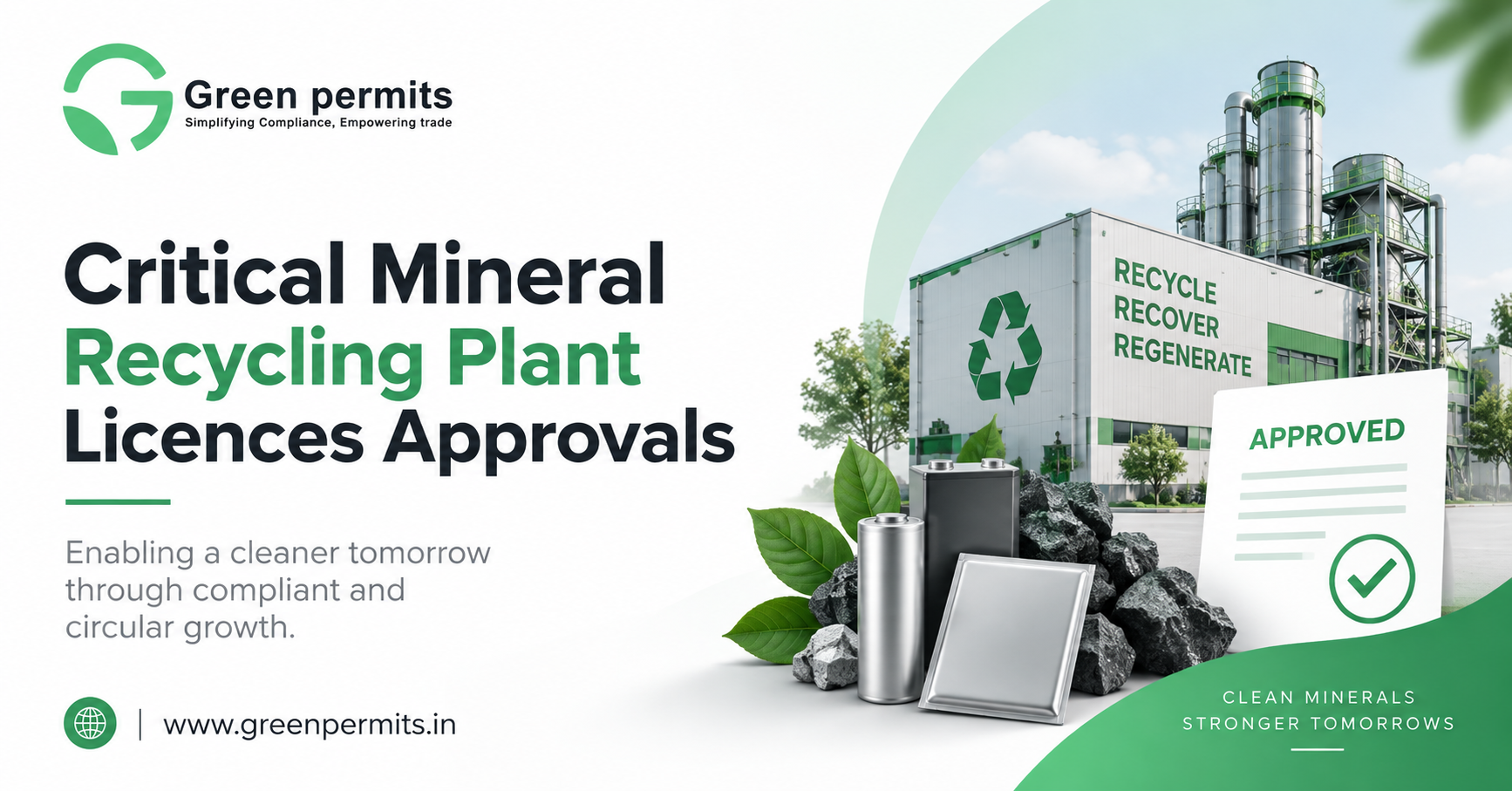
Setting up a Critical Mineral Recycling Plant in India requires careful regulatory planning because the approvals depend on the type of feedstock, recycling technology and final recovered materials.
A plant may recover critical minerals such as lithium, nickel, cobalt, manganese, copper, graphite or other valuable metals from spent lithium-ion batteries, e-waste and industrial scrap. However, a battery recycling facility, an e-waste recycling facility and an integrated hydrometallurgical recovery plant do not follow exactly the same approval route.
The Government is also encouraging domestic recovery of critical minerals. Under the National Critical Mineral Mission, a ₹1,500 crore Critical Mineral Recycling Incentive Scheme has been introduced for recovery from secondary sources including spent lithium-ion batteries, e-waste and other eligible scrap.
Green Permits Consulting supports investors with site assessment, DPR preparation, CTE/CTO, Hazardous Waste Authorisation, CPCB recycler registration and complete recycling plant approval planning.
What is a Critical Mineral Recycling Plant?
A critical mineral recycling plant processes waste or secondary material to recover commercially usable metals or mineral compounds.
Depending on the project, the process may involve:
Feedstock Receiving → Dismantling → Shredding → Physical Separation → Black Mass / Concentrate → Hydrometallurgical or Other Recovery → Recovered Critical Minerals
Some plants stop at mechanical processing or black-mass production, while integrated facilities continue further to extract lithium, nickel, cobalt or other materials.
This distinction is important because the technology directly affects the environmental approvals, machinery, pollution-control systems and project cost.
Is There One Critical Mineral Recycling Licence?
No. There is no single licence called a "Critical Mineral Recycling Plant Licence" that covers every project.
The approval structure depends on what the plant processes.
For example, a facility recycling spent lithium-ion batteries may fall under the Battery Waste Management Rules, 2022, while an e-waste recycling facility operates under the E-Waste (Management) Rules, 2022.
If the project handles hazardous wastes, chemicals or regulated residues, additional requirements under the hazardous-waste framework may also apply.
Therefore, the first step should be to define:
Feedstock → Process → Capacity → Recovered Product → Applicable Rules
Only after this can the complete licence matrix be prepared.
Consent to Establish - CTE
Before establishing an applicable recycling plant, the promoter generally needs to assess Consent to Establish - CTE requirements from the relevant State Pollution Control Board or Pollution Control Committee.
The application normally covers the proposed capacity, recycling process, machinery, water requirement, wastewater, air emissions, chemical use, waste generation and pollution-control systems.
For a hydrometallurgical plant, the regulator may need considerably more process information than for a basic mechanical separation facility because acids, reagents, wastewater and hazardous residues may be involved.
CTE should ideally be obtained before major construction and machinery installation.
Consent to Operate - CTO
After machinery and pollution-control systems have been installed, the plant generally needs to assess Consent to Operate - CTO requirements before starting regular commercial production.
The installed process and capacity should match what was approved during the establishment stage.
If the project changes from simple mechanical separation to chemical recovery, or substantially increases capacity, the earlier approval position may need to be reviewed.
A practical approval sequence is:
Site → CTE → Construction → Machinery & Pollution Controls → CTO → Recycler Registration → Commercial Operations
The exact sequence can vary according to the waste stream and state procedure.
Battery Recycler Registration
If the plant processes waste batteries, the Battery Waste Management Rules, 2022 and subsequent amendments become important.
Applicable battery recyclers need registration within the CPCB framework and must comply with the prescribed recycling, record-keeping and EPR requirements.
This is particularly relevant for plants recovering materials from EV batteries, industrial batteries, portable batteries or other covered battery categories.
The plant should clearly define whether it will perform only dismantling and black-mass production or further chemical recovery.
The regulatory documents, machinery and actual process should remain consistent.
E-Waste Recycler Registration
A plant recovering critical minerals from discarded electrical and electronic equipment may also require CPCB registration as an e-waste recycler.
Under the E-Waste (Management) Rules, 2022, CPCB issues registration to covered recyclers through the EPR framework.
An e-waste project may recover copper, aluminium, precious metals and other materials depending on the feedstock and technology.
If lithium-ion batteries are separated from electronic products, their further treatment should also be assessed under the battery-waste framework rather than assuming the e-waste registration covers everything.
Hazardous Waste Authorisation
Critical mineral recycling can generate hazardous residues, sludge, spent chemicals and other regulated waste streams.
Depending on the process, the plant may therefore need Hazardous Waste Authorisation from the concerned SPCB/PCC under the applicable hazardous-waste regulations.
This becomes particularly important for hydrometallurgical projects using acids or other chemical reagents.
The project should identify where each waste stream will go after processing.
A proper material balance should show:
Incoming Waste → Recovered Material → Recyclable By-products → Hazardous Residue → Final Disposal
A recycling plant should not solve one waste problem while creating another unmanaged waste stream.
Fire and Safety Approvals
Lithium-ion batteries can create fire and thermal-runaway risks, particularly when batteries are damaged, charged or improperly stored.
The project layout should therefore include safe receiving, quarantine, discharge, dismantling and storage areas.
Depending on the facility and state requirements, a Fire NOC, Factory Licence and other industrial safety permissions may also need to be assessed.
For hydrometallurgical operations, chemical storage and worker-safety arrangements also become important.
Safety planning should be completed during plant design, not after machinery installation.
Environmental Controls for Hydrometallurgical Plants
Integrated critical mineral recovery facilities may use processes such as leaching, precipitation, solvent extraction or related chemical recovery techniques.
These processes can generate wastewater, acidic or alkaline streams, fumes and chemical residues.
The project may therefore require an ETP, scrubbers, chemical-storage systems and hazardous-waste management facilities depending on the technology.
Before selecting machinery, the DPR should prepare a complete:
Process Flow + Material Balance + Water Balance + Chemical Balance + Waste Balance
This information is important both for regulatory approvals and for estimating realistic operating costs.
Critical Mineral Recycling Incentive Scheme
The Ministry of Mines launched the ₹1,500 crore Incentive Scheme for Promotion of Critical Mineral Recycling under the National Critical Mineral Mission.
The scheme covers eligible secondary sources such as spent lithium-ion batteries, e-waste and other scrap and is intended to support actual separation and production of critical minerals. The official scheme guidance specifically distinguishes deeper critical-mineral extraction from businesses engaged only in black-mass production.
As of 30 April 2026, the Ministry of Mines reported that 58 companies had been approved as eligible participants, representing around 850 KTPA of pledged capacity and approximately ₹5,000 crore of proposed investment.
This incentive scheme is financial support - it does not replace environmental licences or CPCB/SPCB registrations.
Site Selection Before Applying for Approvals
The site should be selected only after understanding the proposed recycling activity.
A suitable location needs sufficient industrial land, electricity, water, road access, waste-storage space and room for pollution-control systems.
Feedstock logistics also matter.
A lithium-ion recycling plant located far from battery manufacturers, EV clusters or collection networks can face high inbound transportation costs.
Similarly, a chemical recovery plant should consider proximity to chemical suppliers and buyers for recovered products.
Site selection should therefore combine regulatory suitability with commercial feasibility.
DPR for Critical Mineral Recycling Plant
A Detailed Project Report - DPR helps define the project before applications and machinery procurement begin.
The DPR should explain the feedstock, processing capacity, recovery technology, machinery, material balance, land requirement, utilities, environmental controls and recovered products.
It should also estimate CAPEX, OPEX, working capital, recovery yield and expected revenue.
For projects seeking bank or investor funding, the DPR can additionally assess cash flow, break-even, debt servicing and sensitivity to feedstock and metal prices.
The DPR becomes especially important for integrated recovery plants because project economics depend heavily on feedstock chemistry and actual recovery efficiency.
Common Approval Mistakes
One common mistake is purchasing machinery before deciding which regulatory category the plant falls under.
Another is applying as a recycler while the actual installed process cannot produce the recovered materials claimed in the application.
Promoters may also overlook hazardous-waste authorisation, fire requirements or wastewater treatment when planning chemical recovery.
The better approach is:
Feedstock Study → Technology → Site → DPR → CTE → Plant Installation → CTO → Applicable CPCB Registration → Operations
This keeps the technical plant and regulatory approvals aligned.
How Green Permits Helps with Critical Mineral Recycling Plant Approvals
Green Permits Consulting supports investors, recyclers and entrepreneurs with critical mineral recycling feasibility studies, DPR preparation, technology and capacity planning, CTE/CTO, Hazardous Waste Authorisation, Battery Recycler Registration, E-Waste Recycler Registration and environmental compliance planning.
We also help evaluate the approval requirements before machinery and land commitments are finalised.
Learn More About Critical Mineral Recycling Plant Licences & Approvals
If you are planning a critical mineral recycling facility using lithium-ion batteries, e-waste or other secondary materials, the approval route should be determined from the feedstock, technology, capacity and recovered products before construction begins.
Read more about recycling plant setup and approval consulting services here:
👉 https://www.greenpermits.in/09/critical-mineral-recycling-licences-cte-cto-guide/
📞 Get Expert Assistance for Critical Mineral Recycling Plant Setup
If you need help with Critical Mineral Recycling Plant licences and approvals, DPR preparation, CTE/CTO, CPCB registration, Hazardous Waste Authorisation or plant setup, Green Permits Consulting can assist you.
🌐 Website: www.greenpermits.in
📞 Phone: +91 78350 06182
📧 Email: [email protected]
- Ask Nguza
- Food and Recipes
- Lifestyle
- Parenting
- Education
- Career & Business
- Sports
- Entertainment
- Marketing & Blogging
- Travel
- Confessions / Anonymous Talk
- Local News & Gossip
- Memes & Fun
- Art
- Hot Topics / Trending
- Causes
- Crafts
- Dance
- Drinks
- Film
- Fitness
- Food
- Games
- Gardening
- Health
- Home
- Literature
- Music
- Networking
- Other
- Party
- Religion
- Shopping
- Sports
- Theater
- Wellness
- Personal Development
- Technology
- Finance
 English
 Arabic
 French
 Spanish
 Portuguese
 Deutsch
 Turkish
 Dutch
Dutch
 Italiano
 Russian
 Romaian
 Portuguese (Brazil)
 Greek
Greek
