


Key Computer Vision Technologies Used in Construction Site Monitoring
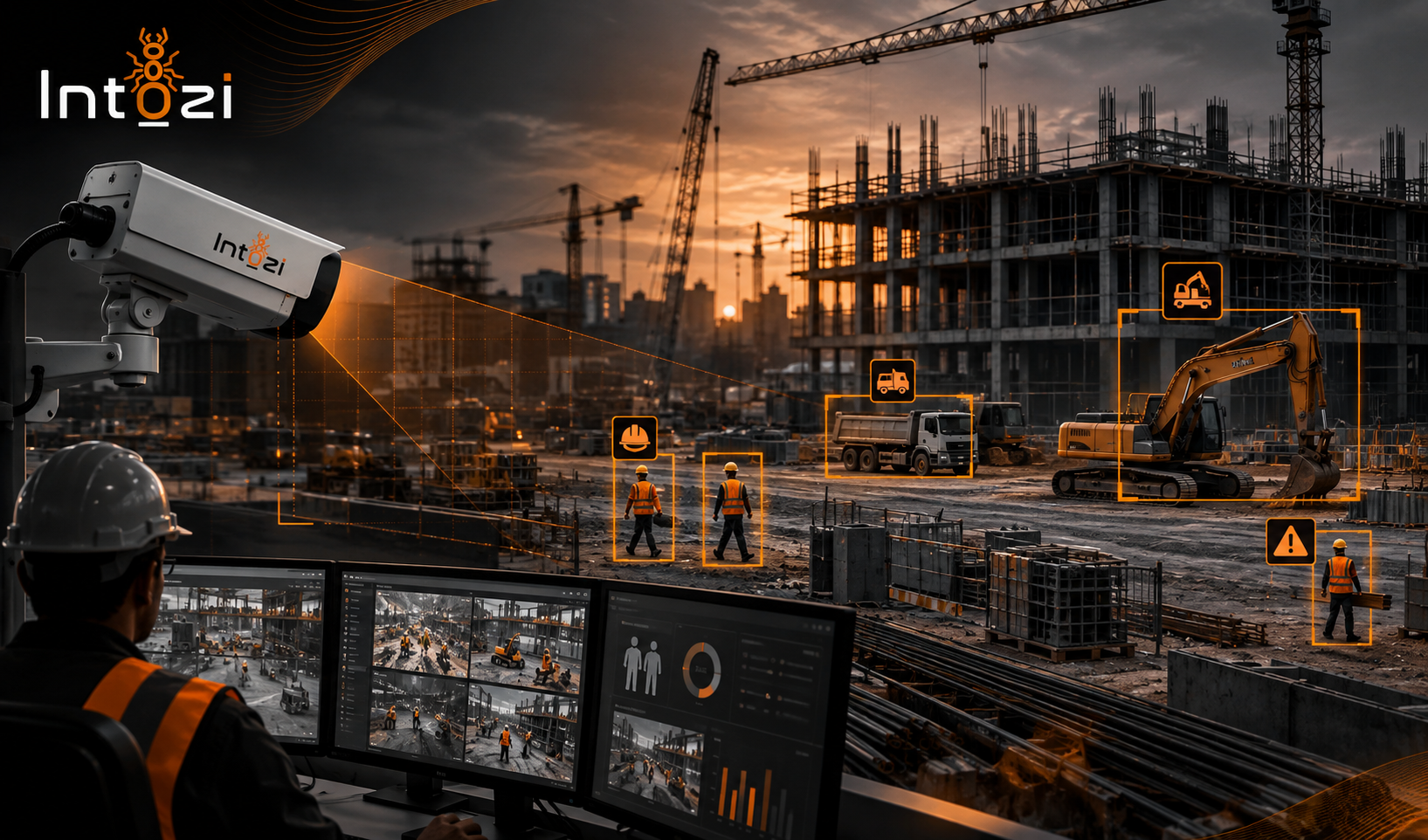
Construction sites involve workers, heavy machinery, vehicles, materials, and constantly changing work zones, making continuous monitoring difficult. Safety teams cannot manually observe every camera feed throughout the day, while conventional CCTV mainly records events for later review. Construction site safety analytics uses computer vision to analyze video streams and identify predefined activities, safety conditions, and potential hazards, providing an additional layer of visibility across active construction environments.
How AI Identifies Workers and Construction Equipment
Computer vision models can identify workers, helmets, trucks, forklifts, cranes, and other objects visible in camera feeds. Object detection determines what is present, while object tracking follows movement across consecutive frames.
This becomes useful when several workers and machines operate simultaneously. Tracking can help determine whether a vehicle has entered a controlled area or whether a worker has moved into a restricted zone.
How AI Supports Worker Safety Analysis
A worker safety analysis system can analyze video for visible PPE and specific worker-related conditions. Depending on camera quality and positioning, AI can identify safety equipment such as helmets and safety vests.
The purpose is not to replace safety officers. Instead, analytics can highlight predefined events for review, helping teams focus their attention on situations that may require investigation or intervention.
How Does Construction Hazard Detection Work?
Construction hazard detection uses computer vision models and predefined rules to identify potentially unsafe conditions visible in video. These may include workers entering restricted areas, people approaching designated machinery zones, or vehicles moving through controlled work areas.
The system needs to be configured according to the actual site layout and safety requirements. Camera positioning, lighting, object visibility, and detection zones can significantly influence results.
How AI-Based Site Monitoring Uses Virtual Zones
Construction projects contain areas with different access and risk levels. AI-based site monitoring can create virtual boundaries within camera views and apply specific rules to each zone.
For example, a project can define machinery areas, vehicle corridors, material storage locations, worker-only sections, and high-risk zones. When a detected person or vehicle crosses a defined boundary, the system can generate an event for further assessment.
How AI Tracks Movement Across Work Zones
Tracking helps analyze the movement of workers, vehicles, and equipment over time. Computer vision follows detected objects across consecutive frames and records their movement within monitored areas.
On larger projects, multiple cameras may cover different work zones. This can provide broader visibility into activities without requiring operators to manually follow every movement across multiple screens.
What Infrastructure Surveillance Solutions Can Monitor
Large infrastructure projects may extend across roads, bridges, tunnels, rail corridors, and other distributed locations. Infrastructure surveillance solutions can therefore be used for more than perimeter security.
Depending on the project, video analytics can support:
-
Worker and vehicle monitoring
-
Restricted-area detection
-
Equipment activity analysis
-
Work-zone monitoring
-
Perimeter observation
-
Safety-event detection
What Affects AI Accuracy on Construction Sites?
Computer vision performance depends on real-world conditions. Camera angle, resolution, lighting, weather, dust, obstructions, and object distance can all affect detection accuracy.
Organizations should therefore test analytics using representative site conditions. False alerts, missed detections, and performance during different times of day are important factors to evaluate before wider deployment.
How Intozi Uses Ikshana for Construction Monitoring
Intozi applies AI video analytics through Ikshana, its AI video analytics platform. In construction and infrastructure environments, Ikshana can analyze camera streams for workers, vehicles, activities, restricted zones, and predefined safety events.
The specific analytics depend on the requirements of each project. The platform can function as an intelligent interpretation layer over existing video infrastructure, helping teams extract structured information from camera feeds.
Why Construction Site Safety Analytics Is Moving Toward AI
Construction sites generate continuous visual information, but identifying important events manually can be difficult at scale. Computer vision technologies such as object detection, tracking, PPE analysis, virtual zones, and construction site safety analytics can help convert video into structured safety and operational events.
For organizations evaluating these technologies, the focus should remain on specific site requirements, camera conditions, detection accuracy, and integration with existing safety processes. Intozi, through Ikshana, applies AI video intelligence to construction and infrastructure monitoring scenarios.
FAQs
Can AI detect workers without helmets?
Yes, AI can detect missing helmets when workers are clearly visible to the camera. Computer vision identifies the worker and checks for expected PPE based on configured analytics. Accuracy depends on camera position, resolution, lighting, and visibility. Such detection is generally used to flag potential non-compliance for review rather than replace safety inspections.
What construction hazards can AI detect?
AI can detect predefined conditions such as restricted-area entry, visible PPE non-compliance, worker presence near designated equipment zones, and vehicle movement through controlled areas. The exact capabilities depend on the selected analytics and camera infrastructure. AI should support safety teams rather than replace established inspections, risk assessments, and safety procedures.
Can AI monitor workers and vehicles together?
Yes, computer vision can identify workers, trucks, forklifts, and other equipment within the same camera view. Different rules can then be applied to each object type. For example, vehicle movement can be monitored in a designated corridor while worker presence is analyzed around restricted areas, providing greater context in busy construction environments.
How does AI-based site monitoring work?
AI-based site monitoring connects camera feeds with analytics models that identify predefined objects, activities, and events. Virtual zones and detection rules can be configured according to the site layout. When a relevant condition occurs, the system can generate an event for review. Camera coverage, connectivity, and environmental conditions influence performance.
What is Ikshana by Intozi?
Ikshana is Intozi’s AI video analytics platform for analyzing live and recorded video streams. It can support applications involving workers, vehicles, activities, restricted areas, and predefined events. In construction environments, its use depends on the project's monitoring requirements, camera infrastructure, and analytics needed for specific safety or operational scenarios.
- Ask Nguza
- Food and Recipes
- Lifestyle
- Parenting
- Education
- Career & Business
- Sports
- Entertainment
- Marketing & Blogging
- Travel
- Confessions / Anonymous Talk
- Local News & Gossip
- Memes & Fun
- Art
- Hot Topics / Trending
- Causes
- Crafts
- Dance
- Drinks
- Film
- Fitness
- Food
- Games
- Gardening
- Health
- Home
- Literature
- Music
- Networking
- Other
- Party
- Religion
- Shopping
- Sports
- Theater
- Wellness
- Personal Development
- Technology
- Finance
 English
 Arabic
 French
 Spanish
 Portuguese
 Deutsch
 Turkish
 Dutch
Dutch
 Italiano
 Russian
 Romaian
 Portuguese (Brazil)
 Greek
Greek
