


How Can Beginners Learn Japanese Phrases Easily?
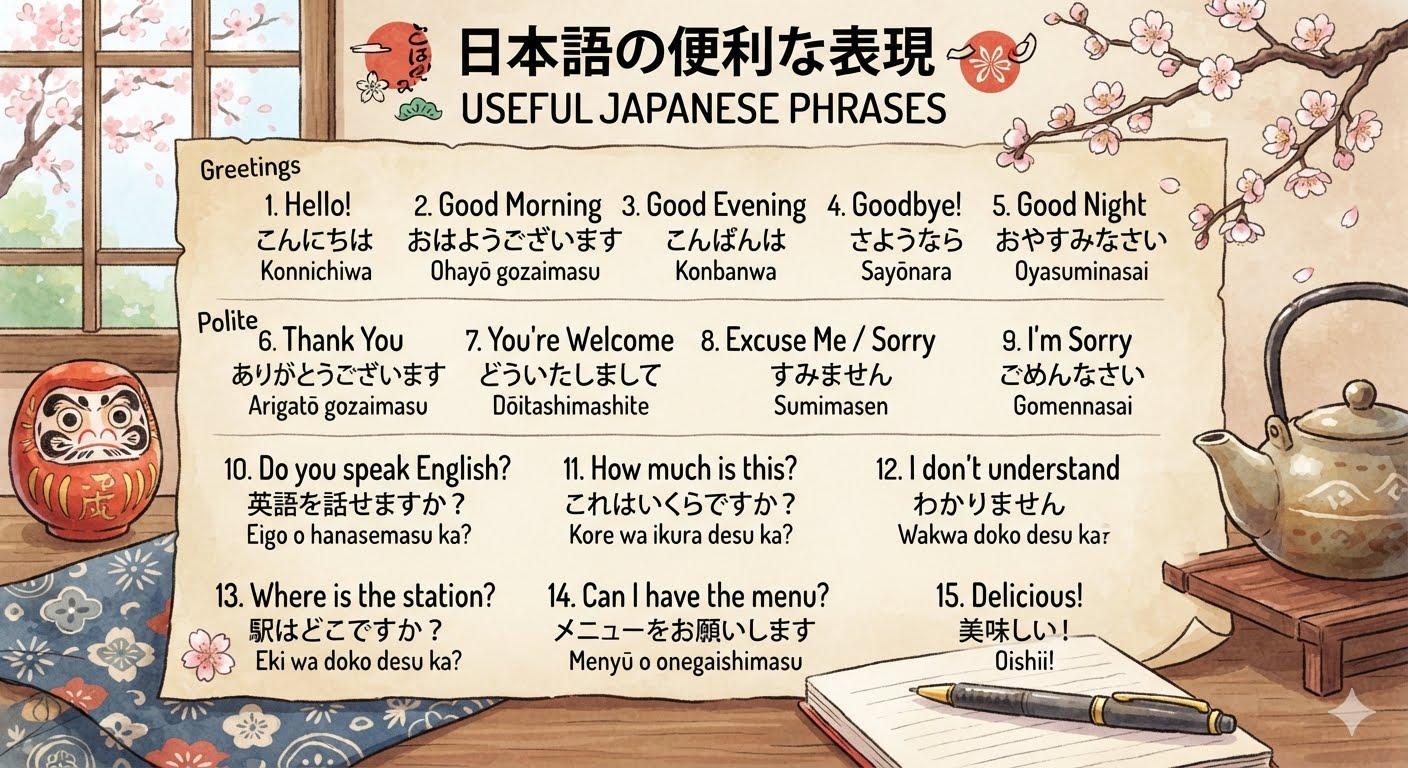
The easiest way to Learn Japanese Phrases is to start with common greetings, daily conversation words, and simple sentences. Beginners should practice listening, speaking, reading, and writing regularly. Learning basic expressions alongside Japanese alphabets can make communication easier and help learners build confidence step by step.
Learn Japanese Phrases: Easy Words and Sentences for Beginners
Learning Japanese can feel challenging at first, especially when you see unfamiliar characters and hear completely new sounds. However, you do not need to memorize thousands of words before starting a conversation. The best approach is to begin with simple and commonly used expressions.
When you Learn Japanese Phrases, you can quickly understand how people greet each other, ask basic questions, order food, introduce themselves, and manage everyday conversations. This practical approach makes language learning more enjoyable for beginners.
Japanese is spoken by more than 120 million people and is one of the most interesting languages for learners interested in Japanese culture, anime, business, travel, and education. Many people also consider Japanese when searching for the best languages to learn for career growth and international opportunities.
This guide will help you understand essential Japanese words, greetings, sentences, and learning methods.
Why Should Beginners Learn Japanese Phrases First?
Vocabulary is important, but individual words do not always help you communicate effectively. Phrases show you how words naturally work together in real conversations.
For example, instead of learning only:
-
Arigatou = Thank you
-
Konnichiwa = Hello
-
Sumimasen = Excuse me
You can learn complete expressions and understand when to use them.
Learning phrases helps beginners:
-
Speak more naturally.
-
Remember vocabulary in context.
-
Understand Japanese conversations.
-
Improve pronunciation.
-
Build confidence faster.
-
Prepare for travel or work situations.
-
Learn sentence structure naturally.
The more useful phrases you know, the easier it becomes to communicate with native speakers.
Basic Japanese Greetings Every Beginner Should Know
Greetings are usually the first step when you Learn Japanese Phrases. Japanese culture places importance on politeness, and greetings can change depending on the time of day and situation.
| Japanese Phrase | English Meaning | Pronunciation |
|---|---|---|
| こんにちは | Hello | Konnichiwa |
| おはようございます | Good morning | Ohayou gozaimasu |
| こんばんは | Good evening | Konbanwa |
| おやすみなさい | Good night | Oyasuminasai |
| さようなら | Goodbye | Sayounara |
| またね | See you | Mata ne |
Konnichiwa: Hello
Konnichiwa is one of the most popular Japanese greetings. It is generally used during the daytime and is appropriate in many situations.
Ohayou Gozaimasu: Good Morning
This is a polite way to say good morning. Friends may simply say "Ohayou," while formal situations usually require "Ohayou gozaimasu."
Konbanwa: Good Evening
Use this greeting when meeting someone during the evening.
Essential Japanese Phrases for Daily Conversations
Once you understand greetings, you can start learning phrases used in regular conversations.
Useful Expressions
| Japanese | English |
|---|---|
| ありがとう | Thank you |
| ありがとうございます | Thank you very much |
| すみません | Excuse me / Sorry |
| ごめんなさい | I am sorry |
| はい | Yes |
| いいえ | No |
| わかりました | I understand |
| わかりません | I don't understand |
| お願いします | Please |
| 大丈夫です | It's okay |
These expressions are useful in schools, workplaces, restaurants, shops, and while travelling in Japan.
How to Introduce Yourself in Japanese
Self-introduction is one of the first practical skills beginners should learn.
A simple introduction looks like this:
Japanese:
はじめまして。
わたしの名前はジョンです。
よろしくお願いします。
English:
Nice to meet you.
My name is John.
Please treat me kindly.
"Yoroshiku onegaishimasu" does not have one exact English translation. It is commonly used when meeting someone for the first time and expresses politeness and goodwill.
When you Learn Japanese Phrases through complete conversations, you start understanding cultural meaning as well as vocabulary.
Common Japanese Questions and Answers
Learning basic questions can help you start conversations.
What is your name?
お名前は何ですか?
Onamae wa nan desu ka?
My name is...
私の名前は___です。
Watashi no namae wa ___ desu.
How are you?
お元気ですか?
Ogenki desu ka?
I am fine.
元気です。
Genki desu.
Where are you from?
どこから来ましたか?
Doko kara kimashita ka?
I am from India.
インドから来ました。
Indo kara kimashita.
These simple questions are excellent practice for beginners learning spoken Japanese.
Japanese Phrases for Travelling
Japan is a popular destination for tourists, students, and professionals. Learning a few practical phrases can make travelling easier.
At a Restaurant
Please give me this.
これをお願いします。
Kore wo onegaishimasu.
Is this delicious?
これはおいしいですか?
Kore wa oishii desu ka?
Water, please.
水をお願いします。
Mizu wo onegaishimasu.
Asking for Directions
Where is the station?
駅はどこですか?
Eki wa doko desu ka?
Please help me.
助けてください。
Tasukete kudasai.
I am lost.
道に迷いました。
Michi ni mayoimashita.
Easy Japanese Sentences for Beginners
Beginners should focus on simple sentence patterns before studying complex grammar.
Here are some examples:
I like Japanese.
私は日本語が好きです。
Watashi wa nihongo ga suki desu.
I am a student.
私は学生です。
Watashi wa gakusei desu.
I want to learn Japanese.
日本語を勉強したいです。
Nihongo wo benkyou shitai desu.
This is interesting.
これは面白いです。
Kore wa omoshiroi desu.
I like Japan.
私は日本が好きです。
Watashi wa Nihon ga suki desu.
Practising these sentences every day can improve your speaking ability.
Should You Learn Japanese Letters A to Z?
Japanese does not have an alphabet exactly like English A to Z. Instead, Japanese writing uses three main systems:
-
Hiragana
-
Katakana
-
Kanji
Before moving into advanced reading, beginners should learn Japanese Letters A to Z equivalents through Hiragana and Katakana charts.
Hiragana
Hiragana is mainly used for native Japanese words and grammar.
Examples include:
-
あ = A
-
い = I
-
う = U
-
え = E
-
お = O
Katakana
Katakana is generally used for foreign words.
For example:
-
コーヒー = Coffee
-
テレビ = Television
-
ホテル = Hotel
Learning these characters can make it easier to read and pronounce Japanese phrases correctly.
For beginners, reading a complete guide on learn Japanese Letters A to Z can provide a strong foundation before moving toward advanced vocabulary and Kanji.
How to Learn Japanese Phrases Faster
There is no single perfect method, but combining different learning techniques usually produces better results.
1. Learn Useful Phrases Instead of Random Words
Focus on expressions you can actually use.
For example:
Instead of memorizing:
-
Food
-
Water
-
Train
-
Hotel
Learn:
-
Where is the hotel?
-
I would like water.
-
Where is the train station?
This method teaches vocabulary and sentence structure together.
2. Listen to Native Japanese Speakers
Listening helps you understand pronunciation, rhythm, and natural expressions.
You can use:
-
Japanese podcasts.
-
Language learning videos.
-
Japanese television programs.
-
Beginner audio lessons.
-
Anime with Japanese subtitles.
However, beginners should not depend only on anime because fictional dialogue may contain informal or exaggerated expressions.
3. Practice Speaking Every Day
Even 10 to 15 minutes of speaking practice can be helpful.
Try:
-
Reading phrases aloud.
-
Repeating audio.
-
Recording your pronunciation.
-
Speaking with language partners.
-
Practising conversations in front of a mirror.
Consistency matters more than studying for many hours once a week.
Learn Japanese Phrases Through Daily Practice
Creating a simple routine can make learning easier.
Morning
Learn five new words or phrases.
Afternoon
Listen to Japanese audio for 10 minutes.
Evening
Practice speaking the phrases aloud.
Before Sleeping
Review everything you learned during the day.
This small routine can gradually improve your vocabulary and speaking confidence.
Are Japanese Proverbs Helpful for Language Learners?
Yes, proverbs can help advanced beginners and intermediate learners understand Japanese culture and traditional thinking.
Many students explore Online Japanese Proverbs to discover meaningful expressions that reflect Japanese history, discipline, relationships, and daily life.
For example:
七転び八起き
Nana korobi ya oki
English meaning: Fall seven times, stand up eight.
This proverb represents persistence and resilience.
Another popular proverb is:
猿も木から落ちる
Saru mo ki kara ochiru
Even monkeys fall from trees.
The meaning is that even experts can make mistakes.
Learning proverbs gives language students exposure to natural vocabulary and cultural concepts.
Is Japanese One of the Best Languages to Learn?
Japanese can be a valuable choice for people interested in international careers, technology, tourism, education, translation, and Japanese companies.
When people search for the best languages to learn, their choice usually depends on personal goals.
Japanese may be suitable if you are interested in:
-
Working with Japanese companies.
-
Studying in Japan.
-
Anime and manga.
-
Japanese culture.
-
International business.
-
Translation careers.
-
Tourism and hospitality.
Japanese requires dedication, especially because of its writing systems. However, regular practice can make the learning process manageable.
Common Mistakes Beginners Should Avoid
Trying to Learn Too Much at Once
Do not memorize hundreds of words in one day. Start with practical vocabulary.
Ignoring Pronunciation
Japanese pronunciation is relatively consistent, but learners should still listen carefully to native speakers.
Learning Only Grammar
Grammar is important, but communication requires listening and speaking practice too.
Avoiding Japanese Writing
Start learning Hiragana and Katakana early. This will help you understand Japanese words better.
Being Afraid of Making Mistakes
Language learning requires practice. Mistakes are a normal part of improving.
A Simple 30-Day Japanese Learning Plan
| Week | Learning Goal |
|---|---|
| Week 1 | Greetings and basic words |
| Week 2 | Self-introduction and daily phrases |
| Week 3 | Travel and conversation phrases |
| Week 4 | Listening, speaking, and revision |
By the end of one month, you may not become fluent, but you can build a strong foundation.
The key is to continue practising and gradually increase your vocabulary.
Frequently Asked Questions About Learning Japanese Phrases
1. What is the easiest way to learn Japanese phrases?
The easiest method is to start with common greetings, daily expressions, and short conversations. Practice phrases repeatedly instead of memorizing isolated vocabulary. Listening to native pronunciation and speaking aloud can also improve memory and confidence.
2. How many Japanese phrases should beginners learn?
Beginners can start with 20 to 50 useful phrases. Focus on greetings, introductions, questions, directions, and common daily expressions. Once these become familiar, gradually add more phrases and vocabulary.
3. Can I learn Japanese phrases online?
Yes. Online courses, videos, language apps, podcasts, and Japanese learning websites provide many resources. A structured online Japanese course can be particularly useful because it combines vocabulary, grammar, pronunciation, listening, and speaking practice.
4. Should I learn Hiragana before Japanese phrases?
You can learn basic phrases and Hiragana at the same time. Speaking phrases helps communication, while Hiragana helps reading and writing. Combining both methods can create a stronger foundation.
5. How long does it take to learn basic Japanese conversation?
With regular practice, many beginners can learn basic greetings and simple conversations within a few weeks. The time required depends on your study routine, previous language experience, and how often you practice.
6. Are Japanese phrases difficult to pronounce?
Japanese pronunciation can be easier for some learners because most sounds are consistent. However, learners should pay attention to vowel length, rhythm, and natural pronunciation by listening to native speakers.
7. What are the first Japanese phrases I should learn?
Start with Konnichiwa, Arigatou, Sumimasen, Onegaishimasu, Hai, Iie, and simple self-introduction phrases. These expressions are commonly used and useful in everyday situations.
8. Can I become fluent by learning Japanese phrases?
Learning phrases alone will not make you fluent, but it provides an excellent starting point. Fluency also requires grammar, vocabulary, listening, speaking, reading, and writing practice.
Related Articles You May Like
To improve internal linking and topical relevance, connect this article with related content such as:
-
Learn Japanese Letters A to Z for Beginners
-
Online Japanese Proverbs and Their Meanings
-
Best Languages to Learn for Career Growth
-
How to Learn Japanese at Home
-
Japanese Books for Beginners
-
Japanese Language Course for Beginners
These internal links can help users explore related topics and improve website navigation.
About the Author
This article is created by a language education content specialist with experience in researching language learning methods, beginner resources, and online education. The content is designed to provide practical and beginner-friendly information for students interested in learning Japanese.
About Our Website
Our platform provides educational resources, language learning guides, professional courses, and practical study materials. Our goal is to help learners find useful information and choose suitable learning paths based on their personal and professional goals.
Contact Us
For course information, educational resources, or general queries, readers can contact our team through the website's official contact page.
We aim to provide accurate, helpful, and regularly updated educational content.
Final Thoughts
Learning Japanese does not require you to understand everything from the first day. Start with simple greetings, common expressions, and useful sentences. As you continue practising, vocabulary and grammar will become easier to understand.
The best way to Learn Japanese Phrases is through regular practice and real-life examples. Combine speaking, listening, reading, and writing to develop your skills naturally.
Start with a few phrases today, repeat them regularly, and slowly build your confidence. Whether you want to travel, study, work, or explore Japanese culture, learning practical Japanese expressions is an excellent first step.
Suggested Trusted Sources
For additional language and cultural information, refer to reliable educational and official resources such as:
-
The Japan Foundation
-
NHK World Japan
-
Japanese Ministry of Education resources
-
Reputable Japanese language education institutions
- Ask Nguza
- Food and Recipes
- Lifestyle
- Parenting
- Education
- Career & Business
- Sports
- Entertainment
- Marketing & Blogging
- Travel
- Confessions / Anonymous Talk
- Local News & Gossip
- Memes & Fun
- Art
- Hot Topics / Trending
- Causes
- Crafts
- Dance
- Drinks
- Film
- Fitness
- Food
- Games
- Gardening
- Health
- Home
- Literature
- Music
- Networking
- Other
- Party
- Religion
- Shopping
- Sports
- Theater
- Wellness
- Personal Development
- Technology
- Finance
 English
 Arabic
 French
 Spanish
 Portuguese
 Deutsch
 Turkish
 Dutch
 Italiano
 Russian
 Romaian
 Portuguese (Brazil)
 Greek
