


Can Business Analytics Skills Connect the Worlds of Business and Technology?

Data has become an important part of modern business, influencing decisions related to customers, sales, finance, operations, marketing, and growth. However, organizations need more than technology to collect and store information. They need professionals who can understand data, recognize business requirements, and convert technical findings into useful recommendations. Business analytics brings these areas together by combining analytical techniques, business knowledge, and digital tools. Professionals with these capabilities can help companies understand their performance and make informed decisions. A Business Analytics Course in Chennai can help learners build practical knowledge of data analysis, visualization, reporting, and business intelligence.
Bridging Business and Technology
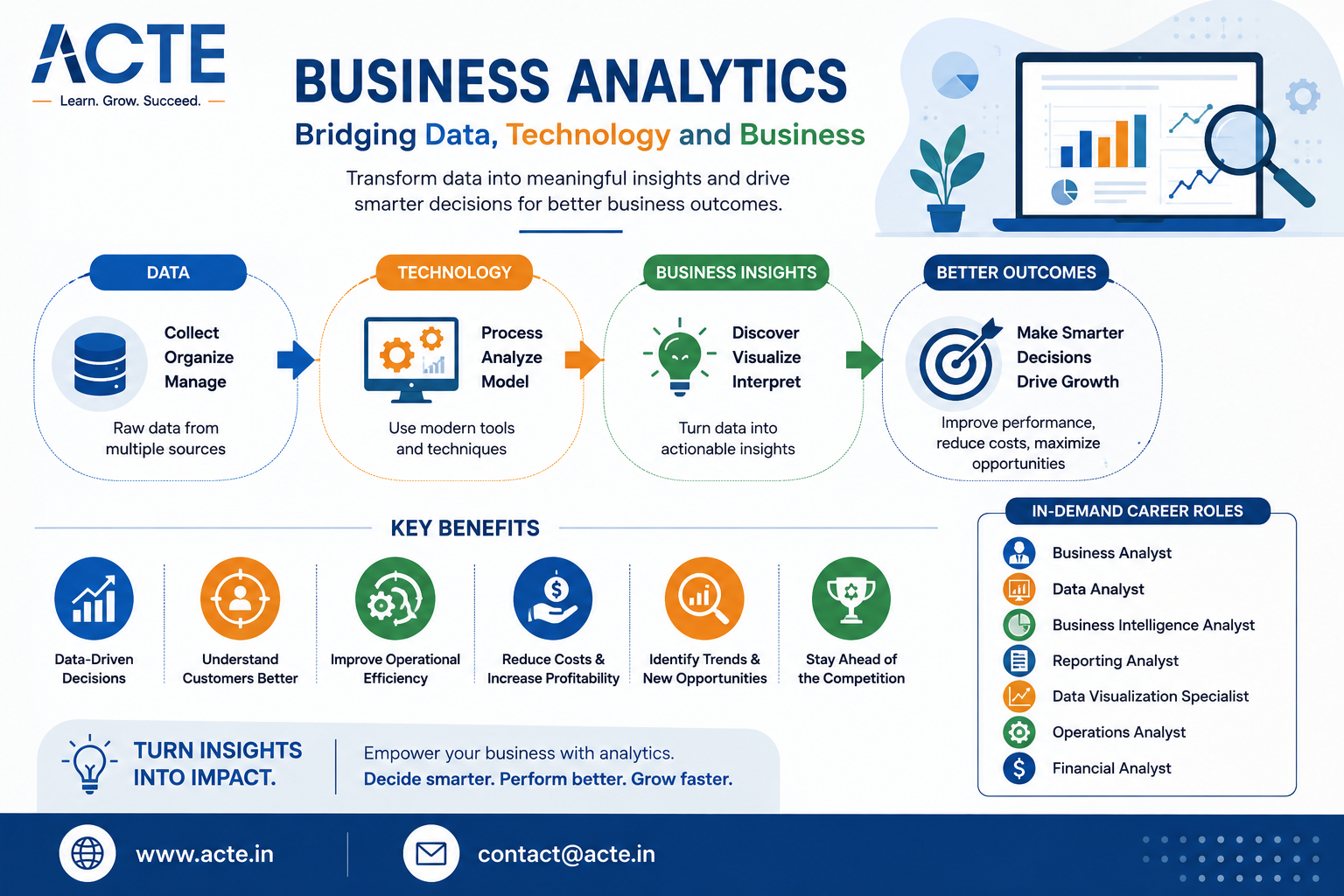
Business analytics creates a connection between business teams and technology teams. Business professionals understand organizational goals, customer expectations, revenue, and operational challenges, while technology professionals manage databases, applications, and data systems. Business analysts can work across both areas by understanding business requirements and using data-driven methods to identify suitable solutions. They can analyze information, communicate findings, prepare reports, and help stakeholders understand the business impact of technical information. This ability to translate between business needs and technology makes business analytics professionals valuable in organizations that increasingly depend on data.
Essential Skills
-
Data Analysis: Identifying patterns, trends, and useful information from datasets.
-
SQL: Retrieving and managing data stored in relational databases.
-
Excel: Performing calculations, analysis, reporting, and data organization.
-
Power BI: Building interactive dashboards and business intelligence reports.
-
Data Visualization: Presenting analytical findings through clear and meaningful visuals.
-
Statistics: Applying statistical methods to interpret data accurately.
-
Business Knowledge: Understanding organizational goals and industry requirements.
-
Critical Thinking: Evaluating information before drawing conclusions.
-
Problem-Solving: Using data to investigate business challenges.
-
Communication: Explaining insights effectively to technical and non-technical stakeholders.
Converting Data Into Insights
Business analytics helps organizations transform raw information into insights that can support practical decisions. Analysts can examine sales figures to identify high-performing products, study customer behavior to recognize purchasing patterns, or evaluate operational data to identify delays and unnecessary costs. These findings can then be presented through reports, dashboards, and visualizations that make complex information easier for decision-makers to understand. Instead of simply reporting what happened, skilled analysts can investigate patterns and provide context that helps businesses determine possible actions. A Business Analytics Course in Bangalore can help learners gain practical experience with analytical tools and understand how data can contribute to business planning and decision-making.
Supporting Cross-Functional Teams
Business analytics professionals often collaborate with departments such as finance, marketing, sales, operations, human resources, and technology. Each department may have different objectives and data requirements, so analysts need to understand their needs before developing reports or analytical solutions. They may gather requirements from business stakeholders, work with technical teams to access relevant data, and then present the results in language that decision-makers can easily understand. Strong communication and collaboration skills therefore complement technical expertise. Business Analytics Training in Hyderabad can help learners develop analytical abilities alongside the communication and problem-solving skills required to work effectively across different teams.
Career Opportunities
-
Business Analyst: Analyzes requirements and helps connect business needs with technology solutions.
-
Data Analyst: Examines datasets and generates useful business insights.
-
Business Intelligence Analyst: Creates dashboards and reports to support organizational decisions.
-
Reporting Analyst: Develops performance reports and analyzes business information.
-
Data Visualization Analyst: Converts complex data into understandable visual presentations.
-
Financial Analyst: Uses financial information to support planning and business evaluation.
-
Marketing Analyst: Studies customer and campaign data to improve marketing activities.
-
Operations Analyst: Uses data to identify process improvements and operational efficiencies.
Expanding Career Potential
Business analytics skills can be applied across industries such as banking, healthcare, retail, manufacturing, logistics, telecommunications, and technology. Professionals can improve their career prospects by combining business knowledge with SQL, Excel, Power BI, statistics, data visualization, and cloud-based analytics tools. Learning emerging technologies such as artificial intelligence and machine learning can further expand their capabilities. With experience, professionals may progress into senior analyst, business intelligence, analytics consulting, product analytics, or management positions. Business Analytics Online Training can offer students and working professionals a flexible way to strengthen their analytical and technical capabilities while preparing for changing industry requirements.
Conclusion
Business analytics provides an effective way to connect business objectives with technology and data. Professionals who understand both areas can translate business requirements into analytical solutions and turn complex information into meaningful insights. Strong abilities in data analysis, SQL, Excel, Power BI, statistics, visualization, communication, and problem-solving can help professionals contribute to data-driven organizations. As businesses continue to adopt digital technologies and rely increasingly on data for decision-making, the ability to understand both business priorities and technical information can become a valuable career advantage. Business analytics can therefore serve as a strong bridge between business and technology while opening opportunities across a wide range of industries.
- Ask Nguza
- Food and Recipes
- Lifestyle
- Parenting
- Education
- Career & Business
- Sports
- Entertainment
- Marketing & Blogging
- Travel
- Confessions / Anonymous Talk
- Local News & Gossip
- Memes & Fun
- Art
- Hot Topics / Trending
- Causes
- Crafts
- Dance
- Drinks
- Film
- Fitness
- Food
- Jeux
- Gardening
- Health
- Domicile
- Literature
- Music
- Networking
- Autre
- Party
- Religion
- Shopping
- Sports
- Theater
- Wellness
- Personal Development
- Technology
- Finance
 French
 English
 Arabic
 Spanish
 Portuguese
 Deutsch
 Turkish
 Dutch
 Italiano
 Russian
 Romaian
 Portuguese (Brazil)
 Greek
