


What Separates an "About Us" Page That Builds Trust From One That Destroys It
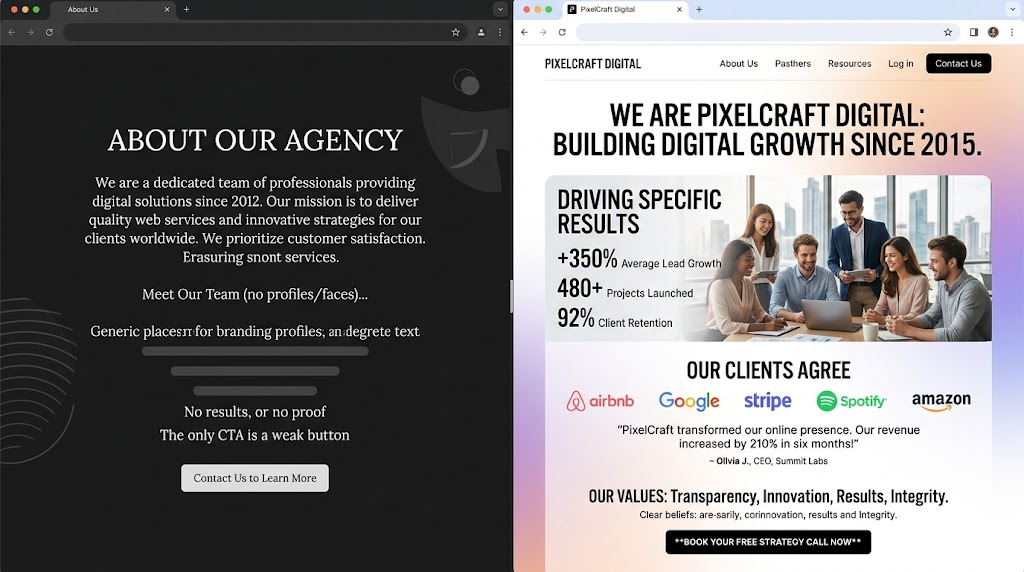
Two businesses can have identical credentials, comparable portfolios, and similar pricing — yet one consistently wins new clients while the other struggles. Often, the difference traces back to a single page that one of them treated carelessly.
Your About page is not a decorative element. It's a decision-making environment. Every word, every image, and every structural choice either moves a visitor closer to reaching out or pushes them back into the arms of a competitor. The margin between those two outcomes is often razor-thin.
People arrive at your About page carrying a specific mental load. They've already sampled your homepage and your service descriptions. What they lack is a feeling — the gut-level conviction that you're legitimate, relevant, and easy to work with. Their visit to this page is an attempt to find that feeling. If your content doesn't provide it quickly, they leave. And they don't come back.
This dynamic plays out identically whether you're an individual freelance website designer or a mid-sized web design company managing dozens of accounts. The principles below apply universally, but the execution matters in the details.
Stop Leading With Your Own Story
The single most ingrained habit in About page writing is the chronological origin narrative. "We started with a dream and a laptop in 2014..." It feels natural. It's also precisely wrong as an opening move.
The reason is straightforward. A visitor at the top of your page hasn't yet decided you're worth learning about. Asking them to invest attention in your history before establishing your relevance is like telling someone your life story before they've asked your name. The information might be interesting eventually — but the timing destroys its impact.
The far better approach is to anchor the opening in the visitor's reality. A web design company might write: "Most of our clients come to us after their second or third attempt at getting their website right. They've already invested time and money, and they're frustrated." That framing does something powerful. It validates the visitor's experience and signals that you've seen this pattern before. Now they want to know more about who you are.
Keep this introductory section to two or three sentences. Acknowledge the problem. Indicate that a solution exists through your work. That's the complete mandate. Your biography, your founding narrative, your credentials — those all land with far greater force once the reader has a reason to care about them.
Build the Page Around What the Visitor Needs to Believe
There are three things every person reading your About page is trying to determine. They may not articulate these consciously, but the entire experience orbits around them:
- 1.Do you have genuine skill in this area?
- 2.Have you applied that skill successfully for others like me?
- 3.Are you someone I could work with comfortably?
Structure your content to answer these sequentially. Each one deserves its own focused treatment.
Ditch the Adjectives, Embrace the Numbers
Sentences filled with superlatives and aspirational language are the fastest route to a disengaged reader. "We deliver innovative, cutting-edge solutions that transform businesses" is a statement so generic it could belong to any company in any sector. It creates no differentiation and builds no trust.
What does build trust is specificity. A website designer might write: "Over the past nine years, I've designed and developed websites for more than 110 professional service firms — accounting practices, law offices, and consulting companies." That sentence has weight. It's checkable. It paints a picture that a reader can evaluate. If your volume of work is still growing, focus on depth rather than breadth. "I build custom Webflow sites exclusively for independent financial advisors" communicates a clear identity that no amount of adjectives could achieve.
Mirror Their Professional World
There is a critical psychological shift that happens when a visitor realizes you've worked extensively with their type of business. It's the difference between evaluating a stranger and recognizing a specialist. That shift accelerates trust faster than almost anything else on the page.
Reference the industries you serve by name. Mention the specific types of challenges those industries face. When a web design company that has built sites for over thirty dental practices states that focus clearly, the dental office administrator reading the page feels a sense of relief. They think: these people already understand what my practice needs.
You don't need lengthy case study write-ups here. A single, focused outcome metric delivers sufficient proof. "Practices we've worked with have experienced an average 42% increase in online appointment bookings after launch." State the figure. Move on. Let dedicated portfolio pages handle the longer narrative.
Show Who Would Actually Be Doing the Work
This is one of those recommendations that everyone agrees with in principle and far too many businesses ignore in practice. Spend an afternoon reviewing competitor About pages and note how many of them contain no human faces, no personal names, no biographical texture at all.
If you work independently as a website designer, displaying your photograph isn't optional. Choose an image that communicates approachability and authenticity. Not a heavily filtered social media portrait, not a stiff corporate headshot — something that makes a potential client think: this is someone I could collaborate with comfortably.
For agencies and studios, display the full team. Names, roles, photographs, and one humanizing biographical detail per person. "Thomas, our project coordinator, previously managed logistics for a major music festival — which explains his uncanny ability to keep complex timelines on track." That kind of detail does something extraordinary. It dissolves the barrier between a business entity and a group of living, breathing individuals. People trust individuals in ways they never trust logos.
Put Your Origin Story in Its Proper Position
Your founding narrative belongs on this page — just not at the top. Its emotional power depends on context. Delivered before the reader understands your competence, it's premature. Delivered after they've seen evidence of your capability, it becomes genuinely compelling.
The ideal version distills your history into three essential beats: the catalyst, the principle, and the practice. What happened that prompted you to begin? What belief crystallized through that experience? And how does that belief define the way you operate today?
Here's an example of that structure working well: "I spent my early career at a large agency where client communication was filtered through three layers of management. When I started my own practice, I made a commitment: clients would always have direct access to the person doing the actual work. That policy hasn't changed in twelve years." That story accomplishes something elegant. It communicates history, philosophy, and a tangible business practice in a single narrative arc. The reader finishes it understanding both where you came from and what working with you looks like.
If any biographical detail doesn't serve the reader's understanding of who you are today, cut it without hesitation.
Declare Your Principles — the Ones That Cost You Something
A brief section on your professional values does double duty. It establishes your authority while simultaneously filtering for the right kind of clients.
Picture a website designer who openly commits to never launching a site without thorough cross-browser and device testing, even for the smallest projects. Stating that standard publicly communicates that you operate from fixed principles rather than situational convenience. It appeals to clients who care about doing things properly. Those looking for the fastest and cheapest option will self-select out — a clean outcome that respects everyone's time.
Specificity always wins over generality. Two or three conviction statements with real edge outperform a long list of safe, forgettable virtues. "We believe in integrity and quality" is noise. "We've recommended that clients delay a launch rather than ship something that doesn't meet our shared standards" is a principle people remember because it implies a real cost. That's what makes a value statement credible — it demonstrates something you're willing to sacrifice for.
Close With a Single, Unmistakable Prompt
An About page without a clear next step is a thoroughfare with no destination. The visitor has just invested several minutes engaging with your content. Their receptivity is at a peak that may not return during their browsing session. Don't abandon them at the finish line.
Offer one call to action, and make it visually dominant. "Browse our latest projects" or "Book a no-pressure conversation" are both effective, depending on your sales approach. The key is singularity. Multiple choices introduce indecision. One choice produces momentum.
For a web design company, a direct link to a curated portfolio section typically outperforms other options. After reading about your philosophy and hearing your story, the reader's immediate instinct is to see the work itself. Satisfy that instinct at the exact moment it surfaces, and the transition from reader to prospect becomes seamless.
Quick Habits That Reinforce Trustworthiness
Speak as yourself. First person sounds like a real human being. Corporate third person reads like a press release. The tonal gap between these two choices influences how every other element on the page is perceived.
Read it out loud. Your ear catches problems your eyes miss. Every sentence that stumbles in natural speech will stumble in print as well. Revise until the rhythm is smooth throughout.
Keep it updated. An About page that references a three-person team when you've grown to eighteen people actively damages the credibility it was designed to establish. Mark your calendar for a thorough audit twice a year and follow through.
Test every sentence for originality. Take each line and ask a direct question: could a competing firm publish this exact sentence on their own About page without raising any eyebrows? If yes, rewrite it until it carries the unmistakable fingerprint of your own experience.
The Insight That Changes How You Approach Everything
Stop thinking of your About page as a place to introduce yourself. Think of it as a place to answer one question that every visitor carries: what do I need to know before I'm ready to trust you?
Answer that question with evidence of real capability. Show them the human beings behind the business. Then make the next step as frictionless as possible. Execute those three fundamentals and your page will outperform the vast majority of competitors — including those with considerably more resources and longer histories.
Revisit your current About page right now with the eyes of someone who has never encountered your business before. The distance between what you've written and what that person needs to find will become apparent almost immediately. Closing that distance is where meaningful, measurable improvement begins.
- Ask Nguza
- Food and Recipes
- Lifestyle
- Parenting
- Education
- Career & Business
- Sports
- Entertainment
- Marketing & Blogging
- Travel
- Confessions / Anonymous Talk
- Local News & Gossip
- Memes & Fun
- Art
- Hot Topics / Trending
- Causes
- Crafts
- Dance
- Drinks
- Film
- Fitness
- Food
- Games
- Gardening
- Health
- Home
- Literature
- Music
- Networking
- Other
- Party
- Religion
- Shopping
- Sports
- Theater
- Wellness
- Personal Development
- Technology
- Finance
 English
 Arabic
 French
 Spanish
 Portuguese
 Deutsch
 Turkish
 Dutch
Dutch
 Italiano
 Russian
 Romaian
 Portuguese (Brazil)
 Greek
Greek
