


Suphini Handmade Dance Shoes: Craftsmanship Behind Every Step

In an era when most footwear rolls off automated assembly lines by the thousands, Suphini Handmade Dance Shoes stands as a quiet rebellion against mass production. The brand has built its reputation on a simple but increasingly rare promise: every pair of shoes is shaped by human hands, guided by decades of accumulated skill rather than programmed machinery. For dancers, this distinction is not a marketing flourish—it is the difference between a shoe that merely fits and one that moves as though it grew from the foot itself. Understanding what goes into a Suphini shoe reveals why handmade craftsmanship still matters in a world that prizes speed above all else.
The Philosophy That Drives the Workshop
Suphini's approach begins with a conviction that dance shoes are instruments, not accessories. A dancer's foot endures extraordinary stress—hours of rehearsals, sudden pivots, repeated rises onto the toes—and the shoe must respond to that demands without adding to them. Rather than designing for the lowest common denominator of foot shapes, the workshop treats each order as a fresh problem to solve. Makers speak of listening to the shoe as it takes form, adjusting tension and shape based on how the materials behave on any given day. This mindset shapes everything from how leather is selected to how long a sole is left to settle before finishing. It is slow work by modern standards, and that is precisely the point.
Selecting Materials That Earn Their Place
Long before a single stitch is sewn, the crafting process starts with material selection, and Suphini treats this stage with unusual seriousness. Hides are inspected by hand for grain consistency, flexibility, and the way they recover after being stretched—qualities that machines cannot reliably judge. Leather destined for the upper must be supple enough to mold to the foot yet resilient enough to hold its shape through countless performances. Soles are chosen for their grip and give, striking a balance between slide and stability that varies depending on the dance style a pair is intended for. Even thread and adhesives are vetted for durability and comfort. Nothing enters the workshop unless it has passed a maker's trained eye and fingertips, because a flaw in the raw material cannot be corrected later in the process.
The Art of Handcrafting Each Pair
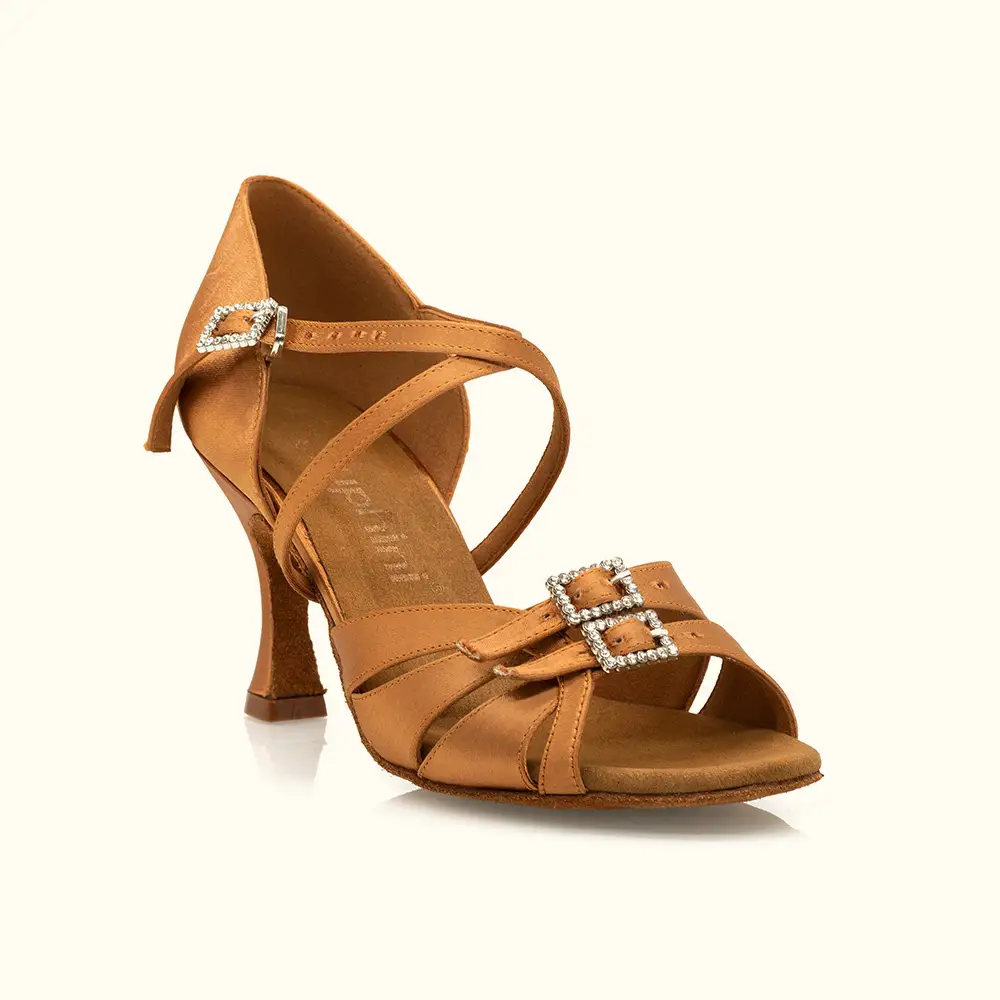
The construction itself unfolds across dozens of small, deliberate steps, most of which cannot be automated without sacrificing quality. Uppers are cut by hand to accommodate the natural asymmetries of individual feet, then shaped over wooden lasts that are adjusted for each order. Skilled makers sew the components together using techniques refined over generations, pulling thread to just the right tension so seams flex without straining. Soles are attached and trimmed with knives rather than dies, allowing the maker to follow the shoe's true contours instead of forcing it into a template. Throughout the process, the shoe is repeatedly tried against measurements and, when possible, the dancer's own feet. Each stage depends on the judgment of the person performing it, which is why no two pairs leave the workshop looking or feeling exactly alike.
Fitting a Shoe to a Dancer, Not a Size Chart
Standard sizing assumes feet come in neat increments, but anyone who has danced for long knows otherwise. Suphini's fitting process acknowledges that width, arch height, toe shape, and even the way a dancer distributes weight all influence how a shoe should be built. Customers provide detailed measurements and descriptions of their needs, and makers use that information to adjust lasts, modify heel placement, and fine-tune the shoe's internal support. Dancers with particularly wide feet, high arches, or past injuries often find that handmade construction is the first time a shoe has truly accommodated them rather than the reverse. This personalization is not an add-on service but the natural outcome of making shoes one pair at a time.
Quality That Reveals Itself Over Time
The true test of any dance shoe comes not on the first wearing but after months of use, and here handmade construction shows its worth. Machine-made shoes often fail at their weakest seams or where adhesives give way, but a Suphini pair is built with repairability in mind. Soles can be replaced, stitching reinforced, and uppers reconditioned, extending the shoe's life far beyond what mass-produced alternatives typically offer. Makers also note that handmade shoes break in differently—molding gradually to the foot rather than collapsing unevenly under repeated stress. Many dancers report that their Suphini shoes feel better in their second year than their first, a testament to materials and techniques chosen for longevity rather than short-term appearance.
A Craft Worth Preserving
Suphini Handmade Dance Shoes represents more than a product line; it is a small stand against the disappearance of handcraft in an industry increasingly ruled by volume. Every pair carries the fingerprints—literally and figuratively—of the people who built it, along with knowledge passed down through careful apprenticeship rather than instruction manuals. For dancers, choosing such shoes is an investment in their own art, a recognition that the tools of performance deserve the same dedication as the performance itself. In a marketplace crowded with disposable options, the workshop's quiet commitment to doing things the hard way remains its most persuasive argument.
- Ask Nguza
- Food and Recipes
- Lifestyle
- Parenting
- Education
- Career & Business
- Sports
- Entertainment
- Marketing & Blogging
- Travel
- Confessions / Anonymous Talk
- Local News & Gossip
- Memes & Fun
- Art
- Hot Topics / Trending
- Causes
- Crafts
- Dance
- Drinks
- Film
- Fitness
- Food
- Games
- Gardening
- Health
- Home
- Literature
- Music
- Networking
- Other
- Party
- Religion
- Shopping
- Sports
- Theater
- Wellness
- Personal Development
- Technology
- Finance
 English
 Arabic
 French
 Spanish
 Portuguese
 Deutsch
 Turkish
 Dutch
 Italiano
 Russian
 Romaian
 Portuguese (Brazil)
 Greek
