


How Bakery Equipment Manufacturer in India Can Optimise Heat Transfer Efficiency, Thermal Uniformity and Energy Consumption Across Industrial Baking Systems
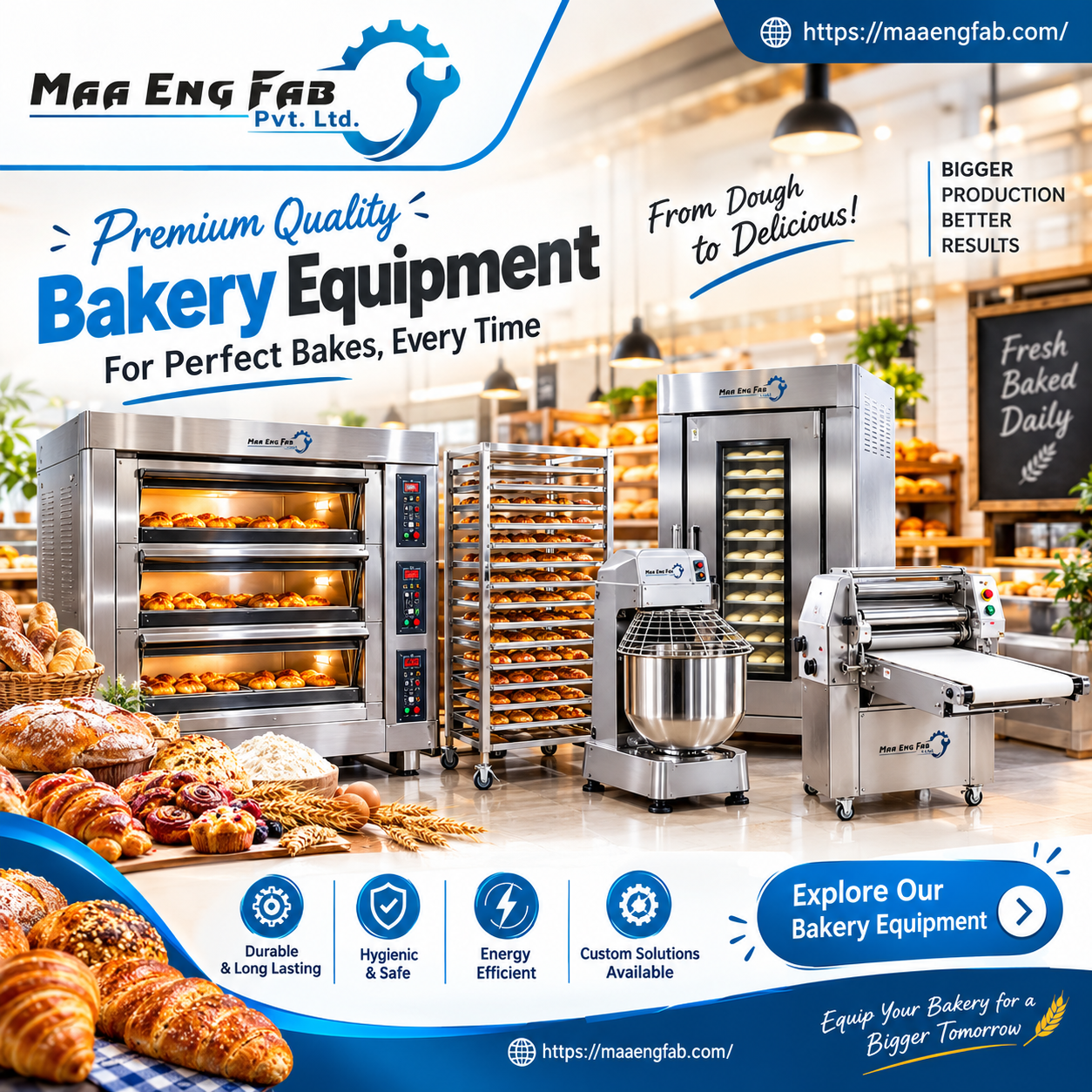
In commercial bakeries and industrial food processing plants, baking quality depends on more than the temperature displayed on an oven control panel. Heat transfer, airflow distribution, product thickness, tray loading, conveyor speed and moisture evaporation all influence the final product. Even small variations in these factors can cause uneven browning, inconsistent texture, excessive moisture loss or underbaked sections.
For this reason, a reliable Bakery Equipment Manufacturer in India must consider thermal performance alongside production capacity, construction quality, energy consumption and ease of operation.
Industrial baking ovens are designed to deliver controlled and repeatable heating across different production conditions. However, achieving uniform results requires appropriate oven design, correct commissioning, suitable operating parameters and regular performance verification.
This guide explains how industrial bakery ovens work, which factors affect heat transfer, how manufacturers and buyers can evaluate energy efficiency, and what technical checks should be completed before purchasing baking equipment.
1. Understanding Industrial Bakery Ovens and Their Applications
Industrial bakery ovens provide controlled heating for products such as bread, buns, biscuits, cookies, cakes, crackers, pastries and other baked goods. The appropriate oven configuration depends on the product, required output, baking profile and production workflow.
Common industrial oven types include:
Convection ovens
Convection ovens use circulating heated air to transfer energy to the product. Fans distribute air throughout the baking chamber, supporting heat exchange between the hot air and product surfaces.
These ovens are useful for many bakery applications, but airflow distribution, fan performance, tray arrangement and product spacing must be evaluated carefully.
Rotary rack ovens
Rotary rack ovens rotate trays or racks during baking. This movement can help reduce differences caused by fixed product positions, although uniform results still depend on airflow, loading density, oven design and recipe requirements.
They are commonly considered for bakeries requiring flexibility across multiple product types and batch sizes.
Tunnel and conveyor ovens
Tunnel ovens move products through heated zones on a conveyor. Baking time is influenced by conveyor speed, oven length, temperature profile and the product's heat-transfer characteristics.
These systems are particularly relevant to continuous production where consistent throughput and repeatability are important.
Deck ovens
Deck ovens transfer heat through heated baking surfaces and the oven environment. They can be suitable for bread, pizza bases and selected bakery products requiring specific bottom-heating characteristics.
When selecting an oven, buyers should match the technology to their products instead of assuming that one oven design is suitable for every baking application.
2. How Heat Transfer Works Inside a Bakery Oven
Three primary heat-transfer mechanisms influence baking performance: conduction, convection and radiation.
Conduction
Conduction transfers heat through direct contact between materials. In bakery production, heat may move from a heated deck or baking tray into the product.
Tray material, thickness, surface condition and contact characteristics can influence the rate of heat transfer. A change in tray design may therefore affect bottom colour, crust development and baking time.
Convection
Convection transfers heat through the movement of air or another fluid. In forced-convection ovens, fans circulate heated air around the products.
Air velocity, direction, temperature and distribution influence surface heating. Poor circulation or obstructed airflow can create localised differences even when the average chamber temperature appears correct.
Radiation
Radiation transfers thermal energy through electromagnetic waves. Heated oven surfaces and heating elements can contribute to radiant heating.
The effect depends on the oven design, surface temperatures, product position and the degree to which the product is exposed to the heat source.
Technical consideration: These mechanisms operate together during baking. Their relative contributions vary by oven type, product composition, geometry, surface condition and process stage.
3. Thermal Uniformity: Why One Temperature Reading Is Not Enough
An oven's displayed temperature usually represents a sensor reading at a specific location. It does not necessarily describe the temperature conditions across the entire baking chamber or the temperature inside every product.
Differences can occur between:
-
The front and rear of the oven.
-
Upper and lower rack positions.
-
The centre and edges of a conveyor.
-
Areas close to heating sources and areas farther away.
-
Lightly loaded and heavily loaded production zones.
These differences may lead to uneven colour, variable texture, inconsistent moisture loss and differences in product dimensions.
How manufacturers can improve thermal uniformity
Oven design should account for heating-zone layout, fan placement, duct design, air-return paths, insulation and the intended loading pattern.
For conveyor ovens, the design should also consider product spacing and the distribution of heat along the conveyor width. For rotary rack ovens, rack movement and airflow around the loaded trays are important.
Thermal performance should be assessed under representative operating conditions rather than only when the oven is empty.
4. Oven Airflow Design and Circulation Performance
Airflow is a major factor in forced-convection baking. The objective is not simply to maximise fan speed; it is to distribute heat appropriately without creating undesirable product drying or surface effects.
Important design factors include:
Fan selection: The fan must suit the required airflow, temperature and operating environment.
Duct geometry: Poorly designed ducts can create uneven distribution, excessive resistance or localised high-velocity zones.
Air-return paths: Restricted return paths may affect circulation and produce temperature differences.
Loading clearance: Trays, racks and products should not block intended air passages.
Fan maintenance: Dust accumulation, worn bearings, damaged blades or drive problems may reduce airflow performance.
Operators should follow the equipment manufacturer's instructions when changing fan settings or adjusting dampers. Excessive airflow can be as undesirable as insufficient airflow for some products.
5. Tray Loading, Product Spacing and Batch Consistency
The way products are placed inside an oven affects heat transfer and moisture removal. Overloading a tray or placing products too close together can restrict air circulation and create local variations in baking conditions.
For example, closely packed buns may shield neighbouring surfaces from direct airflow. Large biscuits placed in different zones may receive different heating conditions if the oven has an uneven temperature profile.
A consistent loading procedure should specify:
-
The number of products per tray.
-
Minimum spacing between products.
-
Tray position and orientation.
-
Permitted rack or conveyor loading density.
-
Maximum batch load within the approved operating conditions.
These parameters should be validated using representative products and recipes. The best loading arrangement depends on product size, shape, formulation and oven design.
6. Temperature Recovery Time and Production Efficiency
Temperature recovery time describes how the oven returns toward its operating setpoint after a disturbance, such as opening a door or introducing a substantial product load.
A slow recovery may affect baking consistency and reduce practical production throughput. However, recovery time alone does not establish whether an oven is suitable: actual product quality and performance under the intended operating cycle must also be assessed.
Factors affecting recovery include:
-
Installed heating capacity.
-
Thermal mass of the oven and loaded trays.
-
Insulation performance.
-
Door-opening frequency and duration.
-
Product load and starting temperature.
-
Air circulation and control-system response.
-
Heating-zone arrangement.
Manufacturers should evaluate recovery under defined operating conditions and avoid presenting empty-oven recovery figures as equivalent to full-production performance.
7. Insulation Quality and Heat Loss Prevention
Oven insulation reduces heat transfer from the hot chamber to the surrounding environment. Suitable insulation can help maintain operating temperatures, reduce unnecessary energy losses and improve workplace conditions around the equipment.
Heat losses may occur through poorly insulated panels, damaged door seals, gaps around access points and unsuitable construction details.
When evaluating insulation, buyers should ask about:
-
Insulation material and suitability for operating temperatures.
-
Panel construction and thermal bridging.
-
Door-seal design and replacement requirements.
-
External surface temperatures under specified conditions.
-
Inspection access and long-term maintenance requirements.
Insulation must be suitable for the oven's temperature range and installation environment. Damaged seals or panels should be addressed according to the manufacturer's maintenance procedures.
8. Energy Efficiency in Industrial Baking Ovens
Energy consumption is a significant component of bakery operating costs. However, a lower-rated heating input does not automatically mean a more energy-efficient oven. Actual performance depends on output, loading, product type, operating schedule and heat losses.
A useful comparison examines energy consumption against a defined production output.
For example, a bakery may track the energy used per kilogram of acceptable finished product. This approach can help reveal whether a change in loading, baking time or oven settings improves overall process efficiency.
Practical methods to improve energy performance
-
Avoid unnecessary empty running during long production gaps.
-
Plan production batches to suit the oven's practical capacity.
-
Maintain door seals and insulation.
-
Inspect fans, drives and heating systems regularly.
-
Use appropriate temperature setpoints for each validated recipe.
-
Review unnecessary temperature overshoot.
-
Reduce avoidable product rejection and rework.
-
Compare energy consumption across similar products and operating conditions.
Energy optimisation must not compromise food safety, baking quality or required product characteristics.
9. Heating Elements, Burners and Temperature-Control Systems
Industrial ovens may use electric heating elements, gas-fired burners or other heating arrangements, depending on the equipment design.
Each system requires appropriate controls, inspections and maintenance.
Electric heating systems
Heating elements can deteriorate, while electrical connections, contactors and control components may develop faults. Uneven heating can result when a heating element fails or a control system does not operate as intended.
Inspection and electrical testing should be performed by qualified personnel according to the manufacturer's procedures.
Gas-fired systems
Gas-fired ovens require appropriate burner operation, fuel supply control, combustion management, ventilation and safety interlocks.
Poor combustion or incorrect burner adjustment can create safety risks and affect heating performance. Servicing must be completed by appropriately qualified technicians.
Temperature sensors and controllers
Temperature sensors provide information to the control system, which regulates heating according to the configured operating logic.
Incorrect sensor placement, sensor drift, damaged wiring or control-system faults can result in a mismatch between displayed and actual process conditions.
Calibration and verification should use suitable reference instruments and documented procedures. The correct calibration interval depends on the equipment, process criticality and operating history.
10. Conveyor Speed, Residence Time and Baking Profiles
In continuous tunnel ovens, conveyor speed determines how long a product remains within the heated chamber. This is often called residence time.
For a simple fixed-length heating zone, residence time can be estimated as:
Residence time = Effective heating-zone length ÷ Conveyor speed
For example, if the effective heating-zone length is 12 metres and the conveyor speed is 0.4 metres per minute, the nominal residence time is 30 minutes.
This calculation is a simplified estimate. The actual baking profile also depends on heating-zone boundaries, product movement, temperature distribution and the machine's operating configuration.
Increasing conveyor speed reduces residence time, while decreasing speed increases it. Either change can affect crust colour, internal moisture, texture and overall baking quality.
Before changing conveyor settings, operators should conduct controlled trials and evaluate the finished product against defined quality criteria.
11. Moisture Loss and Product Quality During Baking
Baking involves physical and chemical changes, including moisture evaporation, structural setting, crust formation and browning reactions. The extent of these changes depends on product composition, geometry, time and temperature.
Excessive moisture loss may result in a dry product, reduced yield or undesirable texture. Insufficient baking may lead to poor structure, unsuitable colour or failure to meet the product's validated process requirements.
To manage moisture-related variation, production teams should monitor:
-
Product weight before and after baking.
-
Product dimensions and surface colour.
-
Internal texture and other defined quality characteristics.
-
Baking time and oven-zone temperatures.
-
Recipe consistency and ingredient variation.
-
Cooling conditions before final product evaluation.
Moisture loss should be interpreted in the context of the product specification. Different bakery products require different moisture and texture outcomes.
12. Thermal Mapping and Oven Commissioning
Thermal mapping helps evaluate temperature distribution at selected locations and under defined operating conditions. It can reveal whether the oven has localised temperature differences that require investigation.
A useful commissioning process may include:
-
Confirming installation and utility connections.
-
Checking safety controls and interlocks.
-
Verifying temperature sensors and control settings.
-
Recording temperature behaviour at selected chamber locations.
-
Testing representative loading patterns.
-
Evaluating baking results using agreed product-quality criteria.
-
Documenting operating settings and acceptance results.
For production-critical applications, temperature measurements may be collected at multiple points and during defined operating cycles. The method should suit the oven configuration and the purpose of the test.
Thermal mapping should not be confused with product-core temperature validation. When a process requires a specific internal product condition, the relevant product measurements and validation criteria must be established separately.
13. Maintenance Practices That Protect Thermal Performance
A well-designed oven can still lose performance if maintenance is neglected.
Routine inspections should consider:
-
Fan condition, drive components and bearings.
-
Heating elements or burner systems.
-
Temperature sensors and control devices.
-
Door seals, insulation panels and access covers.
-
Conveyor alignment, speed and drive condition.
-
Dust or residue accumulation in approved inspection areas.
-
Electrical connections and safety devices.
-
Exhaust, ventilation and other systems specified by the manufacturer.
Maintenance frequency should follow equipment documentation, operating hours and observed condition. Repairs should be recorded so that recurring problems can be identified.
Cleaning and maintenance must also protect food-contact surfaces and prevent tools, lubricants or loose components from contaminating products.
14. How to Select the Right Industrial Bakery Oven
Before purchasing equipment, buyers should define the intended products, production volume, recipe requirements and factory conditions.
A practical supplier-evaluation checklist includes:
Production capacity: Ask for rated output and the operating conditions used to establish it.
Product compatibility: Confirm suitability for the intended recipes, sizes and product characteristics.
Thermal performance: Request information about temperature control, heating-zone design and uniformity testing.
Energy consumption: Compare consumption under equivalent production conditions rather than relying on unqualified efficiency claims.
Construction quality: Evaluate insulation, materials, access panels and ease of maintenance.
Automation and controls: Review temperature settings, alarms, recipe management and relevant safety functions.
Installation requirements: Confirm space, utilities, ventilation and service access.
After-sales support: Ask about operator training, technical documentation, spare parts and maintenance services.
Testing and commissioning: Agree on measurable acceptance criteria before installation.
A qualified Bakery Equipment Manufacturer in India should be able to explain the design assumptions and testing approach relevant to the buyer's application.
15. Common Mistakes When Evaluating Bakery Oven Performance
Several mistakes can lead to incorrect purchasing or operating decisions.
Relying on the displayed temperature alone: A single sensor cannot establish uniform conditions throughout the chamber.
Comparing ovens using different test conditions: Energy use and output should be compared using equivalent products, loading and operating cycles.
Ignoring tray and product arrangement: Loading patterns can influence airflow and baking results.
Changing multiple settings simultaneously: This makes it difficult to identify the actual cause of a quality change.
Assuming faster heating always means better performance: Product quality, energy use and process stability must also be considered.
Neglecting maintenance: Damaged seals, faulty sensors and deteriorating fans can affect thermal performance over time.
Purchasing on rated capacity alone: Practical output depends on the actual product, recipe, loading density and required quality standards.
Frequently Asked Questions
What factors affect heat transfer in industrial bakery ovens?
Conduction, convection and radiation all contribute. Tray material, airflow, product dimensions, loading density, temperature profile and baking time also affect heat transfer.
How can a bakery oven achieve more uniform baking?
Appropriate airflow design, suitable tray spacing, correct loading, calibrated sensors and performance testing under representative production conditions can help improve uniformity.
Why is oven temperature recovery important?
Recovery influences how consistently the oven returns toward its operating condition after loading or door opening. Its significance should be evaluated alongside product quality and actual production output.
How can energy consumption be compared between bakery ovens?
Compare energy use under equivalent operating conditions and relate it to an appropriate output measure, such as kilograms of acceptable finished product.
What should buyers ask a Bakery Equipment Manufacturer in India before purchasing an oven?
Ask about capacity, product compatibility, thermal uniformity, energy consumption, control systems, installation requirements, maintenance, spare parts and commissioning tests.
Does a higher oven temperature always reduce baking time?
Not necessarily. Higher temperatures can change surface browning, moisture loss and product structure. Any adjustment should be validated against the product's required quality and process conditions.
Conclusion
Thermal uniformity and heat-transfer efficiency are essential considerations when selecting and operating industrial bakery ovens. Airflow distribution, tray loading, insulation, temperature-control accuracy, conveyor speed and product moisture all influence the final result.
A dependable Bakery Equipment Manufacturer in India should evaluate oven performance under realistic production conditions and provide clear information about capacity, maintenance, energy consumption and commissioning. Buyers should assess these factors together instead of relying solely on nominal temperature or advertised output.
By combining suitable equipment design with thermal mapping, consistent operating procedures, regular maintenance and evidence-based process optimisation, bakeries can improve product consistency, manage energy costs and make better long-term equipment decisions.
The most effective oven is not simply the one that reaches a target temperature quickly. It is the one that delivers repeatable product quality, reliable output and practical operating performance for the bakery's actual production requirements.
- Ask Nguza
- Food and Recipes
- Lifestyle
- Parenting
- Education
- Career & Business
- Sports
- Entertainment
- Marketing & Blogging
- Travel
- Confessions / Anonymous Talk
- Local News & Gossip
- Memes & Fun
- Art
- Hot Topics / Trending
- Causes
- Crafts
- Dance
- Drinks
- Film
- Fitness
- Food
- Games
- Gardening
- Health
- Home
- Literature
- Music
- Networking
- Other
- Party
- Religion
- Shopping
- Sports
- Theater
- Wellness
- Personal Development
- Technology
- Finance
 English
 Arabic
 French
 Spanish
 Portuguese
 Deutsch
 Turkish
 Dutch
 Italiano
 Russian
 Romaian
 Portuguese (Brazil)
 Greek
