


Davit Arms and Needles Safety Systems: Types, Applications and Selection Guide
Maintaining the exterior of a commercial building can be challenging, particularly when workers need to access high façades, curtain walls, parapets, and other areas that cannot be reached safely from the ground. Window cleaning, façade inspections, painting, and equipment maintenance all require carefully planned access arrangements.
Davit arms and needles safety systems provide engineered support for suspended access and rope access work where conventional access equipment may not be practical. These systems allow compatible ropes, harnesses, and other approved equipment to be positioned beyond a roof edge or parapet, helping trained workers reach designated maintenance areas.
For building owners, facility managers, architects, and construction professionals, choosing the right system means considering more than the equipment itself. Structural capacity, worker movement, access coverage, installation requirements, and rescue arrangements all play an important role.
Safetylyne provides engineered davit systems and other height safety solutions for commercial, industrial, and infrastructure projects across Australia. Its solutions can be designed around building structures and specific façade maintenance requirements.
This guide explains how davit arms and needles work, where they are used, and what to consider when planning a safe and practical suspended access system.
What Are Davit Arms and Needles?
A davit arm is a projecting structural member that supports approved access or fall protection equipment beyond the edge of a building or another structure. It typically connects to a compatible base or mounting arrangement designed to transfer the required loads into the supporting structure.
A needle is a projecting support used in certain suspended access and rope access arrangements. Depending on the system design, it can help position suspension equipment over a parapet, balustrade, or façade edge where direct access from the roof is restricted.
Although the terms are sometimes used together, davit arms and needles are not automatically interchangeable. Their design, mounting method, load capacity, and permitted applications depend on the specific equipment and engineering requirements.
These systems are commonly used for:
-
External window cleaning and façade maintenance.
-
Building inspections and remedial repairs.
-
Rope access to curtain walls and exterior finishes.
-
Maintenance of elevated equipment and architectural features.
-
Selected confined-space entry and retrieval applications when the equipment is specifically designed and approved for that purpose.
The system must be selected for its intended use, with appropriate structural assessment and compatible access equipment.
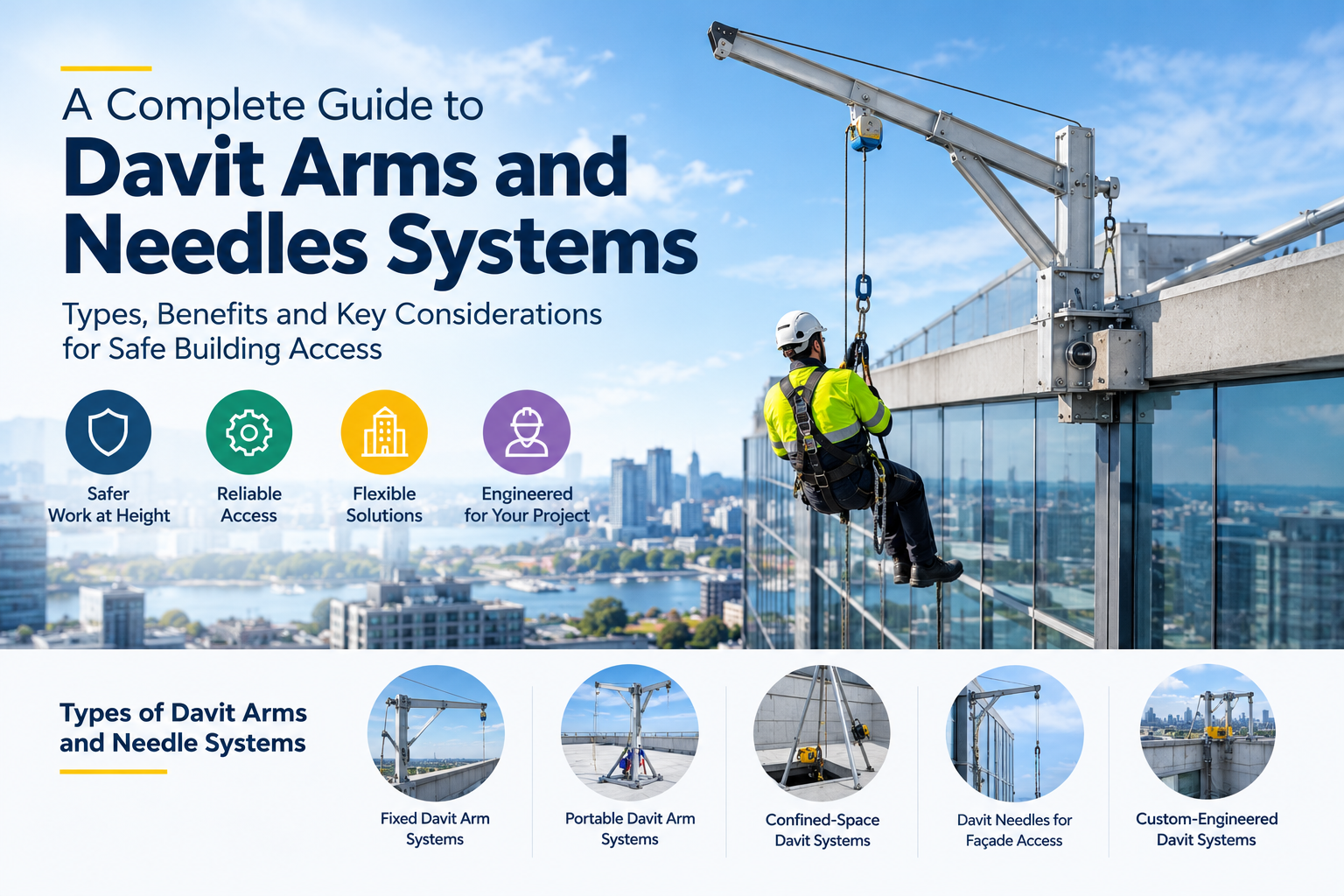
Different Types of Davit Arms and Needle Systems
The most suitable configuration depends on the building's structure, the areas workers need to reach, and how frequently maintenance is performed.
1. Fixed Davit Arm Systems
Fixed systems use a permanently installed mounting base and a compatible davit arm. They can suit buildings that require recurring façade inspections, window cleaning, or exterior maintenance. The mounting arrangement must be engineered for the intended loads and the supporting structure.
2. Portable Davit Arm Systems
Portable arms can be removed and repositioned between compatible, engineered bases. This can be useful when a building has several designated access locations but does not require an arm to remain permanently installed at every point. Portability does not eliminate the need for approved bases, load limits, and correct installation.
3. Confined-Space Davit Systems
These systems can support entry and retrieval arrangements for locations such as access shafts, tanks, and selected service chambers. Depending on the equipment, they may incorporate a compatible winch or retrieval device. A confined-space system requires suitable entry procedures, atmospheric monitoring where needed, and a planned rescue method.
4. Davit Needles for Façade Access
Needle arrangements can project approved suspension equipment beyond a building edge, helping rope access technicians reach exterior surfaces. They may be considered for façades with parapets, balustrades, or other architectural features that complicate direct access. The structure and suspension arrangement must be assessed as a complete system.
5. Custom-Engineered Davit Systems
Some buildings require a bespoke arrangement because of unusual roof geometry, restricted space, architectural details, or complex maintenance routes. Custom engineering can help coordinate mounting positions, arm reach, access coverage, and compatibility with other height safety equipment.
Safetylyne's davit arm and needle systems can be considered as part of a building-specific access strategy. The company also provides façade maintenance access systems that combine different access and fall protection components where required.
Key Benefits of Davit Arms and Needles Safety Systems
Access to Difficult-to-Reach Building Exteriors
Modern buildings often include glass façades, recessed windows, external ledges, and architectural features that make maintenance difficult. Davit systems can provide suitable suspension positions for approved rope access arrangements, allowing trained technicians to reach areas that may be inaccessible from conventional platforms.
Flexible Maintenance Arrangements
Depending on the design, portable arms and permanent mounting bases can provide access to multiple designated locations. This flexibility may be useful for buildings with extensive façades or several maintenance zones.
Integration With Existing Height Safety Equipment
Davit systems can be designed alongside anchor points, static lines, access walkways, guardrails, and roof access systems. Coordinating these components helps create a more complete route from the roof access point to the area where work needs to be performed.
Support for Long-Term Building Maintenance
When access requirements are considered during the building design stage, suitable mounting locations and maintenance routes can be incorporated into the project. This can reduce the need for improvised access arrangements when the building later requires cleaning, inspection, or repairs.
Solutions for Complex Structures
Custom-designed systems may be appropriate for buildings with unusual parapets, limited roof space, or architectural constraints. Safetylyne's work on projects such as Brisbane's Kangaroo Point Green Bridge demonstrates how davit arms can form part of a broader engineered maintenance access solution.
How to Choose the Right Davit System for Your Project
Selecting a davit arm or needle system requires a detailed understanding of the structure and the work being performed.
1. Identify the maintenance task.
Determine whether the system will support window cleaning, façade repairs, inspections, rope access, or confined-space retrieval. These activities may require different equipment and design considerations.
2. Assess the supporting structure.
The roof slab, structural steel, wall, or mounting base must be suitable for the forces imposed by the system. A qualified engineer should verify the connection and supporting structure rather than relying on the strength of the visible mounting surface alone.
3. Calculate the required reach and coverage.
Consider the height of the façade, the distance beyond the parapet, the location of maintenance zones, and how workers will move between access positions. An unsuitable reach can leave parts of the building inaccessible or create additional hazards.
4. Confirm equipment compatibility.
The davit, suspension equipment, ropes, connectors, harnesses, and any winch or fall protection devices must be approved for the intended application. Equipment should never be combined solely because the components appear to fit together.
5. Plan for rescue and emergencies.
A safe work method should address what happens if a worker becomes suspended, equipment fails, or access is interrupted. Rescue arrangements need to be practical for the specific building and task.
6. Consider exposure and maintenance.
Outdoor installations may be exposed to rain, coastal air, corrosion, and other environmental conditions. Appropriate materials, inspection procedures, and maintenance arrangements help preserve the system's condition.
7. Review installation and certification requirements.
Ask the supplier about engineering documentation, installation procedures, testing requirements, user training, and the records that will be provided at handover.
Davit Arms vs Anchor Points: Which Is More Suitable?
Both systems can form part of a height safety solution, but they serve different purposes.
|
Feature |
Davit arms and needles |
Anchor points |
|---|---|---|
|
Main function |
Position approved access or fall protection equipment beyond an edge |
Provide an attachment point for compatible safety equipment |
|
Reach |
Can project equipment beyond a parapet or building edge |
Reach depends on the anchor location and connected system |
|
Typical applications |
Façade maintenance, rope access, and selected retrieval tasks |
Roof maintenance, fall restraint, and fall arrest |
|
Structural requirements |
Requires a suitable mounting arrangement designed for the intended loads |
Requires a suitable anchor device and supporting structure |
|
Best suited to |
Tasks requiring a specific suspension or equipment position |
Tasks that can be safely performed from designated attachment locations |
Neither option is automatically better for every project. Some buildings need anchor points alone, while others require davit arms, needles, or a combination of systems to provide the required access coverage. The choice should follow a site-specific assessment.
Australian Standards and Safety Requirements
Davit systems must be designed, installed, inspected, and used in accordance with the requirements relevant to their particular application.
The precise standards and editions applicable to a davit installation depend on its design, intended function, and regulatory context. A device intended for fall arrest should not automatically be assumed suitable for personnel lifting, suspended work positioning, or rope access.
Before a system enters service, the project team should confirm the applicable design requirements, structural capacity, installation details, inspection arrangements, and operating procedures. Workers must also be trained and competent in the equipment they use.
Why Work With Safetylyne for Davit Systems?
Building access requirements are rarely identical from one project to another. A high-rise office façade, an industrial facility, and a bridge maintenance project may all require different access methods and structural arrangements.
Safetylyne provides engineered height safety and access solutions, including davit arms and systems for façade maintenance. Its broader services include site assessments, engineering, fabrication, installation, and certification.
When evaluating a supplier, look for:
-
Experience with similar building structures and maintenance requirements.
-
Engineering support for mounting arrangements and structural loads.
-
Suitable equipment for the intended suspension or fall protection application.
-
Integration with existing access and height safety systems.
-
Clear installation records, inspection requirements, and handover documentation.
Planning these details early can help building owners and project teams establish a practical maintenance strategy while accounting for safety and compliance requirements.
Frequently Asked Questions
1. What is a davit arm used for?
A davit arm positions compatible access or fall protection equipment beyond an edge or opening. It is commonly used for façade maintenance, rope access, suspended work positioning, and certain confined-space retrieval applications when designed for that purpose.
2. What is a davit needle?
A davit needle is a projecting support used in certain suspended access arrangements. It helps position the required suspension equipment beyond a parapet or building edge so workers can access designated exterior areas.
3. Are davit arms permanent or portable?
Both configurations are available. Fixed systems remain installed at designated locations, while portable arms can be moved between compatible engineered bases. The correct option depends on the maintenance schedule, site layout, equipment requirements, and approved system design.
4. Can davit systems be used for window cleaning?
Yes. Appropriately designed davit systems can support approved rope access arrangements for window cleaning and façade maintenance. The full system must be suitable for the task and operated by trained personnel.
5. Do davit arms require regular inspection?
Yes. Inspection and maintenance requirements depend on the equipment, manufacturer instructions, applicable standards, and conditions of use. Inspections should be carried out by competent personnel, with additional checks following events that may affect the system's integrity.
6. Can davit arms be installed on existing buildings?
Potentially, yes. Existing buildings can be assessed for suitable mounting locations and structural capacity. An engineer must determine whether the structure can accommodate the required loads and whether modifications or additional support are necessary.
Plan Your Building's Height Safety System With Safetylyne
Davit arms and needles can provide valuable access solutions for buildings where exterior maintenance is difficult or conventional access equipment is impractical. Their effectiveness depends on appropriate engineering, compatible equipment, safe installation, and a clear plan for operating and maintaining the system.
Whether you are planning a new commercial building, upgrading an existing façade maintenance system, or assessing access options for an industrial facility, start by identifying the work that needs to be performed and the structural conditions at the site.
Visit Safetylyne to explore its height safety solutions, or view the dedicated Davit Arms and Needles page to discuss a suitable system for your project.
- Ask Nguza
- Food and Recipes
- Lifestyle
- Parenting
- Education
- Career & Business
- Sports
- Entertainment
- Marketing & Blogging
- Travel
- Confessions / Anonymous Talk
- Local News & Gossip
- Memes & Fun
- Art
- Hot Topics / Trending
- Causes
- Crafts
- Dance
- Drinks
- Film
- Fitness
- Food
- Games
- Gardening
- Health
- Home
- Literature
- Music
- Networking
- Other
- Party
- Religion
- Shopping
- Sports
- Theater
- Wellness
- Personal Development
- Technology
- Finance
 English
 Arabic
 French
 Spanish
 Portuguese
 Deutsch
 Turkish
 Dutch
 Italiano
 Russian
 Romaian
 Portuguese (Brazil)
 Greek
