


Belgium Driving Laws: Speed Limits on Urban Roads, Highways and Motorways
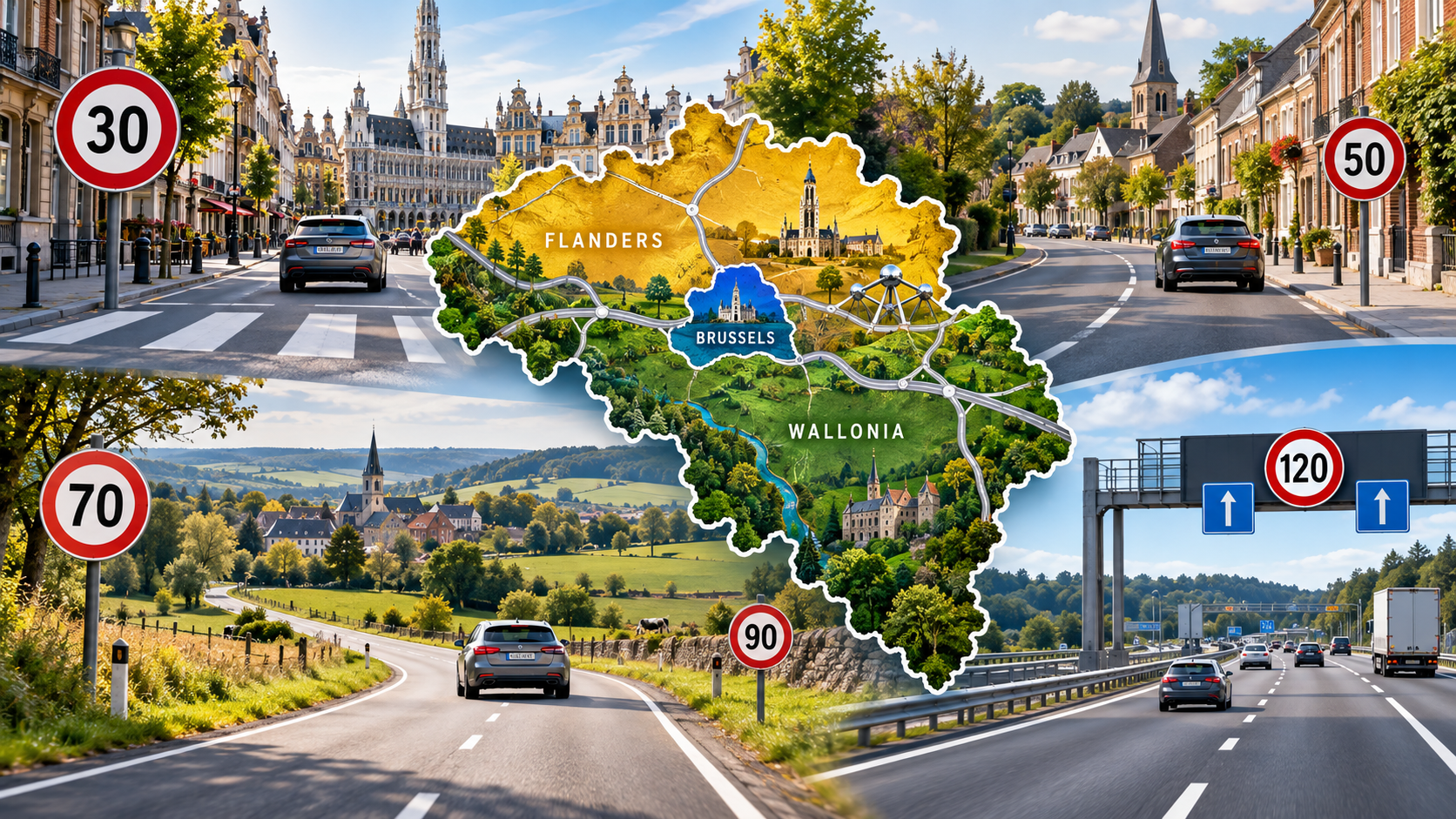
Driving in Belgium can be confusing for new drivers because speed limits are not always identical across the country. Belgium is divided into different regions, and the default limits on certain roads can vary between Flanders, Wallonia, and Brussels. Anyone learning Belgium driving laws should therefore pay attention not only to the type of road, but also to local signs and regional rules.
That is especially important for learner drivers, visitors, and people preparing for a Belgian driving theory test. A road that looks similar in two regions may have a different default limit.
Why Speed Limits in Belgium Can Be Confusing
Belgium driving rules use a combination of national regulations, regional rules, and posted road signs.
The safest habit is simple: always check the signs first.
A posted speed-limit sign overrides the general default where applicable. This means you should never rely only on memory, especially when moving between urban roads, rural roads, and motorways.
For most drivers, the biggest questions are:
-
What is the normal speed limit in towns?
-
What is the limit outside built-up areas?
-
Is the motorway limit always 120 km/h?
-
Why do limits differ between Flanders and Wallonia?
-
What happens in 30 km/h or residential zones?
Understanding those differences is a core part of traffic rules Belgium learners should review.
Urban Roads: 50 km/h Is Not Always the Whole Story
Under the general Belgian road code, the standard speed limit inside built-up areas is 50 km/h unless another limit is shown.
But drivers should not assume every urban road allows 50 km/h.
Many towns and cities use lower limits, especially in:
-
School areas
-
Residential streets
-
Cycling zones
-
Busy shopping districts
-
Pedestrian-heavy areas
-
Traffic-calmed neighbourhoods
In several places, 30 km/h zones are increasingly common. These are designed to reduce stopping distance and improve safety for pedestrians and cyclists.
For someone studying Belgium driving laws, the key point is that the sign at the start of the zone matters. If you enter a 30 km/h area, the lower limit continues until the restriction ends or another limit is posted.
What About Brussels?
Brussels deserves special attention because city speed policy is stricter than many drivers expect.
Large parts of the Brussels-Capital Region operate under lower urban speed limits, with 30 km/h applying widely except where signs permit a different speed.
This makes Brussels an important example of why traffic rules Belgium cannot always be reduced to one national number.
If you are driving in Brussels, read the road signs carefully and do not assume that a broad urban road automatically allows 50 km/h.
Rural Roads in Flanders
Outside built-up areas, speed limits depend heavily on the region.
In Flanders, the standard limit on many ordinary roads outside built-up areas is 70 km/h, unless signs indicate a different limit. Flemish traffic rules also allow 120 km/h on certain divided roads that meet the required design conditions.
That means a road outside a town does not automatically allow 90 km/h.
This is a common mistake for drivers who learned in another European country.
When preparing for Belgium driving rules, remember that Flanders often uses 70 km/h as the default on ordinary roads outside built-up areas.
Rural Roads in Wallonia
Wallonia follows a different default approach.
Under the Walloon rules, many roads outside built-up areas have a general limit of 90 km/h, while certain divided roads can allow up to 120 km/h. Lower or higher limits can still be imposed through road signs.
So the same general-looking rural road may have a different default limit depending on whether you are in Flanders or Wallonia.
This regional difference is one of the most useful things for learners and visitors to understand.
Motorway Speed Limits
For ordinary passenger vehicles, the general maximum speed on Belgian motorways is 120 km/h unless a lower limit is posted.
However, that does not mean you should always drive at 120 km/h.
Roadworks, congestion, poor weather, electronic signs, or temporary restrictions can lower the permitted speed.
Drivers should also remember that safe speed depends on the situation. Heavy rain, fog, dense traffic, or limited visibility may require a much lower speed even when the legal maximum remains higher.
The road code also includes special motorway rules. For example, certain vehicles must follow lower limits, and ordinary stopping or parking on motorways is prohibited except in designated or emergency situations.
Is There a Minimum Motorway Speed?
Belgian motorway rules also address vehicles travelling unusually slowly.
Under the current road code, drivers on a motorway generally may not travel below 70 km/h unless a lower speed is required by traffic conditions, safety needs, or a posted sign.
This does not mean drivers should maintain 70 km/h in a traffic jam or dangerous weather. Safety rules always require speed to be adjusted to actual conditions.
The purpose of the minimum is to prevent vehicles that are not suitable for motorway speeds from creating danger under normal conditions.
30 km/h, 20 km/h and Other Special Zones
Belgium driving laws also include lower-speed environments.
In Wallonia, for example, current rules specify 30 km/h in areas such as cycling zones and certain raised traffic-calming sections, while meeting or residential-style zones can carry a 20 km/h limit.
These lower limits exist because pedestrians and cyclists are more exposed in these environments.
Learners should get into the habit of spotting zone-entry signs early. Missing a zone sign can mean continuing at the wrong speed for several streets.
Do Speed Limits Change in Bad Weather?
A legal speed limit is a maximum, not a promise that the road is safe at that speed.
Rain, fog, snow, standing water, darkness, and heavy traffic can all increase stopping distance or reduce visibility.
A driver following Belgium driving rules correctly should reduce speed when conditions demand it, even if no temporary lower limit has been posted.
This matters in theory-test questions too. The safest answer is often based on adapting to conditions rather than simply choosing the highest permitted number.
What Should Learner Drivers Remember?
The easiest way to study Belgian speed rules is to separate them into road types and regions.
Inside built-up areas, 50 km/h remains an important general reference, but local 30 km/h limits are common. Outside towns, Flanders commonly uses 70 km/h on ordinary roads, while Wallonia generally uses 90 km/h on many comparable roads. Motorways generally allow up to 120 km/h for standard passenger cars unless signs say otherwise.
But the road sign in front of you always matters more than a number you memorised.
Check the Road, Region and Signs
Understanding Belgium driving laws becomes much easier once you stop thinking of speed limits as one nationwide table.
Ask three questions while driving:
Where am I?
What type of road am I on?
What does the current sign say?
That approach helps with both real driving and theory-test preparation.
For more information about Belgium driving rules, road signs, priority rules, theory-test topics, and regional traffic differences, visit the Belgium Driving Licence Guide and continue reviewing the rules most relevant to your route and licence preparation.
- Ask Nguza
- Food and Recipes
- Lifestyle
- Parenting
- Education
- Career & Business
- Sports
- Entertainment
- Marketing & Blogging
- Travel
- Confessions / Anonymous Talk
- Local News & Gossip
- Memes & Fun
- Art
- Hot Topics / Trending
- Causes
- Crafts
- Dance
- Drinks
- Film
- Fitness
- Food
- Games
- Gardening
- Health
- Home
- Literature
- Music
- Networking
- Other
- Party
- Religion
- Shopping
- Sports
- Theater
- Wellness
- Personal Development
- Technology
- Finance
 English
 Arabic
 French
 Spanish
 Portuguese
 Deutsch
 Turkish
 Dutch
Dutch
 Italiano
 Russian
 Romaian
 Portuguese (Brazil)
 Greek
Greek
