


AI-Powered Desalination Market Size, Share & Growth Outlook
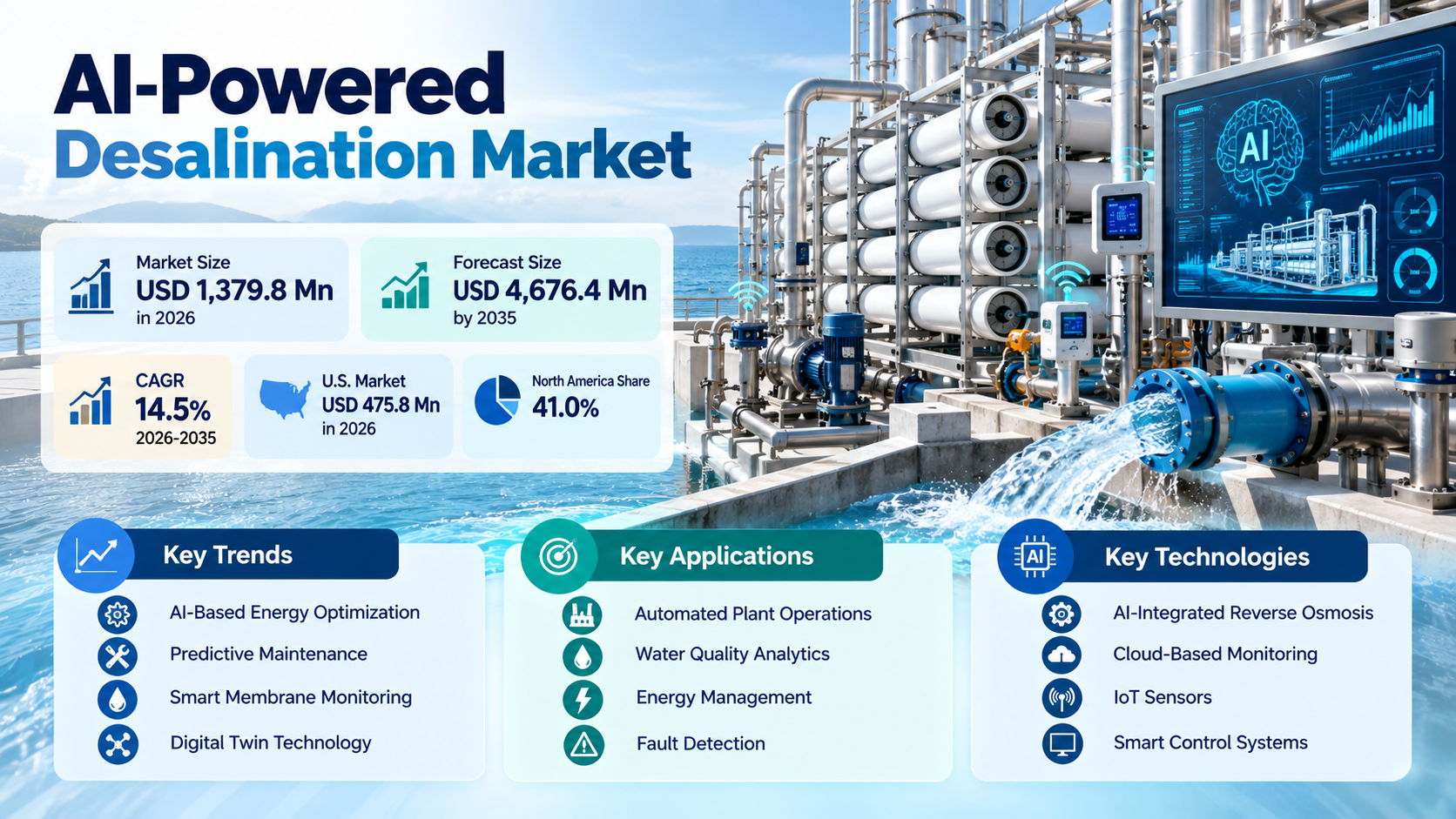
The AI-Powered Desalination Market is transforming water treatment by combining artificial intelligence, advanced analytics, automation, smart sensors and digital control systems with desalination technologies. Water utilities and industrial operators are increasingly adopting intelligent solutions to improve plant efficiency, monitor equipment performance, optimize energy use and maintain reliable water production.
The market is projected to reach USD 1,379.8 million in 2026 and is expected to reach USD 4,676.4 million by 2035, expanding at a CAGR of 14.5% from 2026 to 2035. The U.S. market is projected to reach USD 475.8 million in 2026 and USD 1,499.8 million by 2035.
As desalination plants become more digitally connected, AI is being applied to predictive maintenance, energy optimization, automated plant operations, smart membrane monitoring and water quality analytics. These capabilities are helping operators respond to changing operating conditions while improving asset reliability and resource efficiency.
What Is the AI-Powered Desalination Market?
AI-powered desalination refers to the integration of artificial intelligence and digital technologies into desalination plants to improve monitoring, control, maintenance and operational decision-making.
The market includes hardware, software and services. Hardware includes IoT sensors, smart meters, pumps, energy recovery devices and smart control systems. Software includes AI analytics platforms, monitoring and automation software, predictive maintenance tools and digital twin software. Services include installation, integration, consulting, maintenance and technical support.
AI can analyze operational information from pumps, membranes, sensors and other plant equipment to identify performance changes and support faster decision-making. This is particularly relevant for facilities where energy consumption, membrane fouling and equipment downtime have a direct impact on operating costs.
Why Is the AI-Powered Desalination Market Growing?
Increasing pressure on water resources is encouraging utilities and industries to invest in more efficient water treatment infrastructure. At the same time, desalination plants are becoming more complex, increasing the need for advanced monitoring and automated control.
One of the strongest areas of demand is energy optimization. Desalination can require substantial energy, particularly in processes involving high-pressure pumping or thermal treatment. AI-based systems can evaluate operating conditions and support optimization of pressure, recovery rates, pump operation and other variables.
Predictive maintenance is another important growth factor. AI systems can analyze equipment data and identify patterns associated with potential failures, allowing operators to plan maintenance before an unexpected breakdown affects production.
The increasing availability of cloud-based platforms, IoT sensors, digital twins and real-time analytics is further supporting the adoption of intelligent desalination technologies.
Key Trends Shaping the AI-Powered Desalination Market
AI-Based Energy Optimization
Energy management is becoming a major application area for AI in desalination. Intelligent platforms can analyze electricity consumption, water quality, pressure and other operating variables to identify opportunities for more efficient plant operation.
Predictive Maintenance
Predictive maintenance software is helping operators monitor high-pressure pumps, membranes and other critical assets. Early detection of abnormal operating patterns can support planned maintenance and reduce unplanned downtime.
Digital Twin Technology
Digital twins allow operators to create digital representations of desalination processes and equipment. These systems can be used to simulate operating conditions, evaluate process changes and support plant optimization.
Cloud-Based Water Management
Cloud-based deployment provides centralized access to operational data and analytics. It can support remote monitoring, cross-site performance analysis, software updates and integration with connected sensors.
Smart Membrane Monitoring
AI-powered membrane monitoring is gaining attention as operators seek to identify fouling, scaling and other performance issues earlier. Better monitoring can help improve membrane performance and extend operating life.
Get a Free Sample of the AI-Powered Desalination Market Report
Access a free sample to review market segmentation, forecast analysis, regional insights, competitive developments and research methodology.
https://dimensionmarketresearch.com/request-sample/ai-powered-desalination-market/
Key Factors Driving Market Growth
Increasing Water Stress
Growing demand for dependable freshwater supplies is encouraging investment in desalination and advanced water treatment systems. Municipal utilities and industrial users are increasingly looking for technologies that can improve reliability while managing operating costs.
Need for Lower Energy Consumption
Energy represents an important operating consideration for desalination facilities. AI-powered energy optimization can help operators identify more efficient operating conditions and improve the utilization of pumps, membranes and energy recovery systems.
Digital Transformation of Water Infrastructure
Water utilities are gradually adopting connected sensors, automation platforms, analytics and cloud infrastructure. This digital transformation creates opportunities for AI-powered solutions that can turn operational data into actionable insights.
Growth of Industrial Water Treatment
Industries including oil and gas, power generation, chemicals, pharmaceuticals and semiconductor manufacturing require dependable water supplies. AI-enabled desalination can support operational monitoring, water quality management and equipment reliability in these applications.
Market Segmentation
The AI-Powered Desalination Market is segmented based on component, deployment mode, desalination technology, water source, AI application and end user.
By Component
- Hardware
- IoT Sensors
- Smart Meters
- Pumps & Energy Recovery Devices
- Smart Control Systems
- Software
- AI Analytics Platforms
- Monitoring & Automation Software
- Predictive Maintenance Software
- Digital Twin Software
- Services
- Installation & Integration
- Consulting Services
- Maintenance & Support
The software segment is expected to hold a leading position as demand increases for AI analytics, predictive maintenance, plant optimization and digital twin capabilities.
By Deployment Mode
- Cloud-Based
- On-Premise
- Hybrid Deployment
Cloud-based deployment is expected to remain an important approach because of its scalability, remote accessibility and ability to manage large volumes of operational data.
By Desalination Technology
- AI-Integrated Reverse Osmosis
- AI-Enabled Multi-Stage Flash
- AI-Driven Multi-Effect Distillation
- AI-Based Electrodialysis
- AI-Assisted Nanofiltration
- Hybrid AI Desalination Systems
AI-integrated reverse osmosis is expected to represent a major technology segment because of the widespread adoption of reverse osmosis in desalination facilities.
By Water Source
- Seawater
- Brackish Water
- Wastewater & Recycled Water
- Surface Water
- Groundwater
Seawater represents an important water-source segment because of the use of large desalination facilities in coastal areas.
By AI Application
- Predictive Maintenance
- Energy Optimization & Management
- Automated Plant Operations
- Smart Membrane Monitoring
- Water Quality Analytics
- Fault Detection & Leakage Monitoring
- Digital Twin & Process Simulation
Energy optimization and management is projected to remain a major application area because of the importance of energy efficiency in desalination operations.
By End User
- Municipal Water Utilities
- Industrial
- Oil & Gas
- Power Generation
- Mining
- Chemicals
- Food & Beverage
- Pharmaceuticals
- Semiconductor Manufacturing
- Agriculture & Irrigation
- Defense & Marine
- Commercial Facilities
Municipal water utilities represent a major end-user group, while industrial applications are also creating demand for intelligent water treatment solutions.
Regional Outlook
North America
North America is projected to hold a 41.0% market share in 2026, supported by investment in water technology, digital infrastructure and desalination modernization. The U.S. market alone is projected to reach USD 475.8 million in 2026 and USD 1,499.8 million by 2035, growing at a CAGR of 13.6%.
Europe
The Europe AI-Powered Desalination Market is estimated at USD 382.0 million in 2026 and is projected to reach USD 1,270.0 million by 2035, representing a CAGR of 14.0%. Demand is supported by water management initiatives, energy optimization requirements and increasing adoption of digital water technologies.
Asia Pacific
Asia Pacific is expected to experience strong growth as urbanization, industrialization and water infrastructure investment increase demand for intelligent desalination solutions. Countries such as China, India, Japan, Singapore and Australia are important markets for advanced water management technologies.
Japan
The Japan market is projected to reach USD 145.0 million in 2026 and USD 462.0 million by 2035, growing at a CAGR of 13.2%. Demand is supported by smart water infrastructure, automation and efforts to modernize aging water treatment systems.
Key Challenges
Integration With Legacy Systems
Many water facilities operate with established SCADA, PLC and industrial control systems. Integrating modern AI platforms with existing infrastructure can require extensive planning, testing and cybersecurity measures.
High Initial Investment
AI-powered sensors, control systems, analytics platforms and digital twin technologies can require significant upfront investment. Operators may need to demonstrate measurable operational savings before implementing large-scale digital transformation projects.
Data Quality and Availability
AI models depend on reliable operational data. Inconsistent historical information, limited sensor coverage and disconnected systems can affect the performance of analytics and predictive maintenance applications.
Skilled Workforce Requirements
The integration of water treatment expertise, AI, data analytics and operational technology requires specialized skills. Organizations may need additional training, consulting or managed services to implement and maintain AI-enabled systems.
Growth Opportunities
AI-Ready New Desalination Infrastructure
New desalination facilities provide opportunities to integrate AI, IoT sensors, digital twins and intelligent control systems from the initial design stage. This can reduce the complexity associated with retrofitting legacy infrastructure.
Industry-Specific AI Solutions
Customized AI platforms for semiconductor manufacturing, pharmaceuticals, oil and gas, power generation and other industries can address sector-specific water quality and reliability requirements.
Autonomous Plant Operations
Increasing automation creates opportunities for intelligent systems capable of monitoring plant conditions, identifying abnormal events and supporting automated operational adjustments.
Energy and Sustainability Optimization
AI can help operators evaluate energy use, membrane performance, chemical dosing and other operating variables. This creates opportunities for solutions focused on improving plant efficiency and resource utilization.
Future Outlook
The AI-Powered Desalination Market is expected to continue expanding as water utilities and industrial users adopt digital technologies to improve plant efficiency and operational reliability.
AI analytics platforms, predictive maintenance software, digital twins, cloud deployment and smart control systems are expected to remain important areas of development. Reverse osmosis is also expected to remain a key technology for AI integration because of its broad use in desalination.
The market is projected to grow from USD 1,379.8 million in 2026 to USD 4,676.4 million by 2035, reflecting a CAGR of 14.5%.
As organizations focus on energy management, water quality, asset reliability and automated operations, AI-powered technologies can become an increasingly important part of modern desalination infrastructure.
Explore the Complete AI-Powered Desalination Market Report
For detailed market sizing, segmentation, regional analysis, competitive landscape and growth opportunities, explore the complete research report.
https://dimensionmarketresearch.com/checkout/ai-powered-desalination-market/
Frequently Asked Questions
What is the size of the AI-Powered Desalination Market?
The AI-Powered Desalination Market is projected to reach USD 1,379.8 million in 2026 and USD 4,676.4 million by 2035, growing at a CAGR of 14.5%.
What is driving the AI-Powered Desalination Market?
Key growth factors include increasing water stress, demand for energy optimization, predictive maintenance, digital transformation and the need for reliable water treatment infrastructure.
Which component segment is expected to lead the market?
Software is expected to hold a leading position as demand grows for AI analytics platforms, predictive maintenance software, monitoring tools and digital twin solutions.
Which desalination technology is important for AI integration?
AI-integrated reverse osmosis is a major technology segment because reverse osmosis is widely used and offers opportunities for AI-based energy, membrane and process optimization.
Which region holds a significant market share?
North America is projected to hold a 41.0% market share in 2026, supported by advanced water technology adoption and investment in desalination modernization.
Conclusion
The AI-Powered Desalination Market is moving toward more intelligent, connected and automated water treatment operations. AI analytics, predictive maintenance, smart membrane monitoring, digital twins and energy optimization are creating new opportunities for utilities and industrial users.
With the market projected to reach USD 4,676.4 million by 2035, continued investment in digital water infrastructure, advanced desalination technologies and AI-enabled operational management is expected to shape the market's development through the forecast period.
- Ask Nguza
- Food and Recipes
- Lifestyle
- Parenting
- Education
- Career & Business
- Sports
- Entertainment
- Marketing & Blogging
- Travel
- Confessions / Anonymous Talk
- Local News & Gossip
- Memes & Fun
- Art
- Hot Topics / Trending
- Causes
- Crafts
- Dance
- Drinks
- Film
- Fitness
- Food
- Juegos
- Gardening
- Health
- Home
- Literature
- Music
- Networking
- Other
- Party
- Religion
- Shopping
- Sports
- Theater
- Wellness
- Personal Development
- Technology
- Finance
 Spanish
 English
 Arabic
 French
 Portuguese
 Deutsch
 Turkish
 Dutch
 Italiano
 Russian
 Romaian
 Portuguese (Brazil)
 Greek
